速览:一页看懂 V4.1-Flash
长程智能体(long-horizon agent)的工作负载是"输入重"的:每次工具调用都带来大量 prefill 请求,数百万 token 的上下文要在 HBM、SSD 与主机内存之间搬运。DeepSeek-V4.1-Flash 的全部设计都围绕一个问题展开:在性能不倒退的前提下,把 KV Cache 的算力、存储、带宽三个成本同时压到最低。
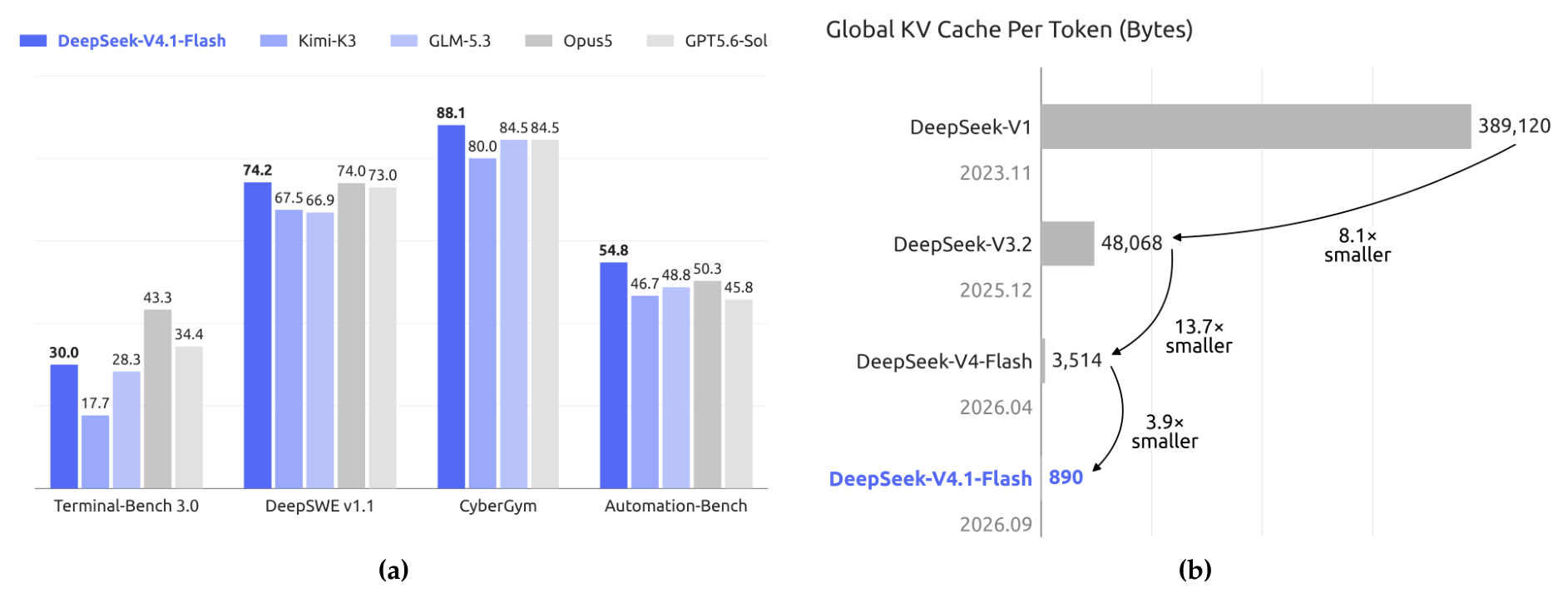
报告首页的两张图分别回答"性能如何"与"省了多少":
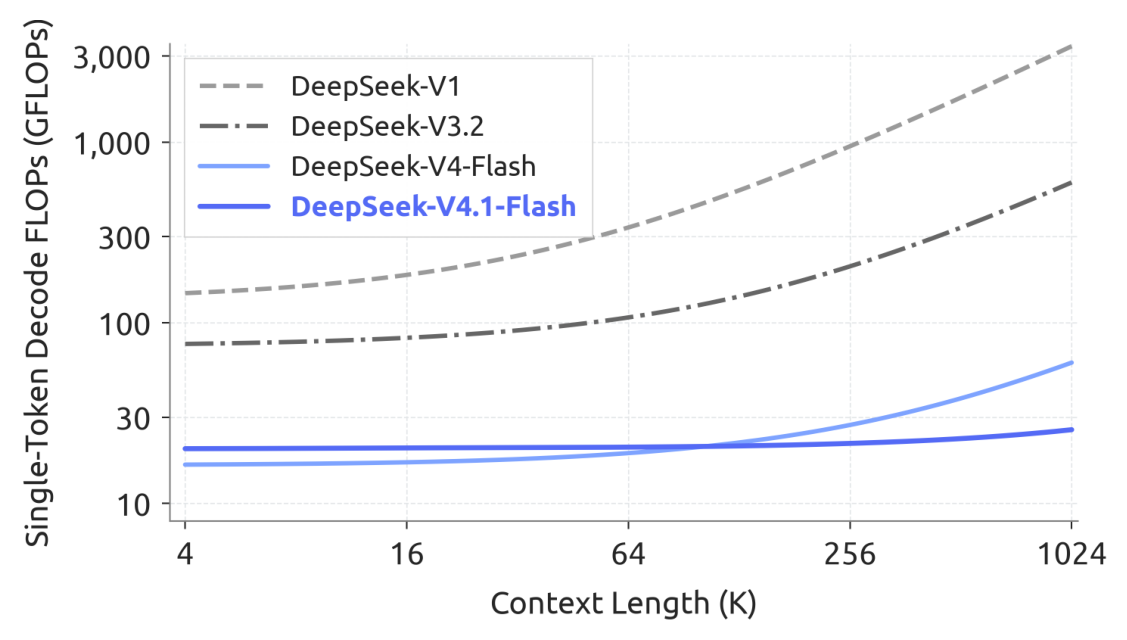
第二个关键收益是"计算恒定":得益于稀疏注意力与投机解码等设计,单 token 解码的计算量几乎不随上下文变长而增长:
💡 点击任意图片可查看原始高清大图,再次点击或按 Esc 关闭。
背景与动机:算力、存储、带宽的三重瓶颈
智能体应用爆发后,模型的负载形态变了:一次任务要在数小时里反复调用工具,每一轮都携带越来越长的上下文。报告把部署成本拆成三笔账:
- 计算:KV Cache 未命中时的 prefill 非常昂贵——尽管稀疏注意力(DeepSeek-V3.2、V4)已经大幅降低了长序列处理成本,prefill 依然是大头;
- 存储:全局 KV 常驻 HBM,受显存容量约束;持久 KV(供前缀复用)落在 SSD / 主机内存,受容量与留存时长约束;
- 带宽:缓存的迁移与加载受 I/O 与互连带宽限制,直接限制服务吞吐。
DeepSeek-V4 的注意力是"全局分支 + 每层滑动窗口(SWA)"的混合:全局分支维护全局 KV(主 KV + 索引器 K),SWA 维护局部 KV。窗口固定时 SWA 存储有界,序列足够长时全局 KV 主导运行时占用。既然 V4 已经把"算"压得足够低,"存"和"搬"就成了新的主瓶颈——这正是 V4.1-Flash 的发力点。
作者给了一个很清晰的概念重构:DeepSeek-V4 本质上是"SWA 局部处理骨干 + 压缩的全局上下文"。顺着这个视角,V4.1 的改造策略就是:保留局部 SWA 设计不动,集中简化全局分支。由此得到三个互相配合的设计——CSA2(跨层共享全局 KV 与索引)、FP4 全局 KV(减半存储)、SWA Bounded Replay(不持久化 SWA KV)。此外,模型从 V4 的 CSA+HCA 混合架构改为纯 CSA2,进一步简化。
架构总览:40 层 CED + 多模态通路
DeepSeek-V4.1-Flash 是一个多模态 MoE Transformer:图像与文本输入,自回归生成文本。语言骨干共 40 层因果 Transformer,组织成"20 层因果编码器 + 20 层解码器"的 CED 结构;除前两层只用 SWA 外,每层都同时有全局注意力与滑动窗口注意力(SWA)。视觉侧由 ViT 编码器 + MLP 投影器把图像转成视觉嵌入,与文本嵌入一起送入骨干——多模态数据从预训练第一天就参与训练。
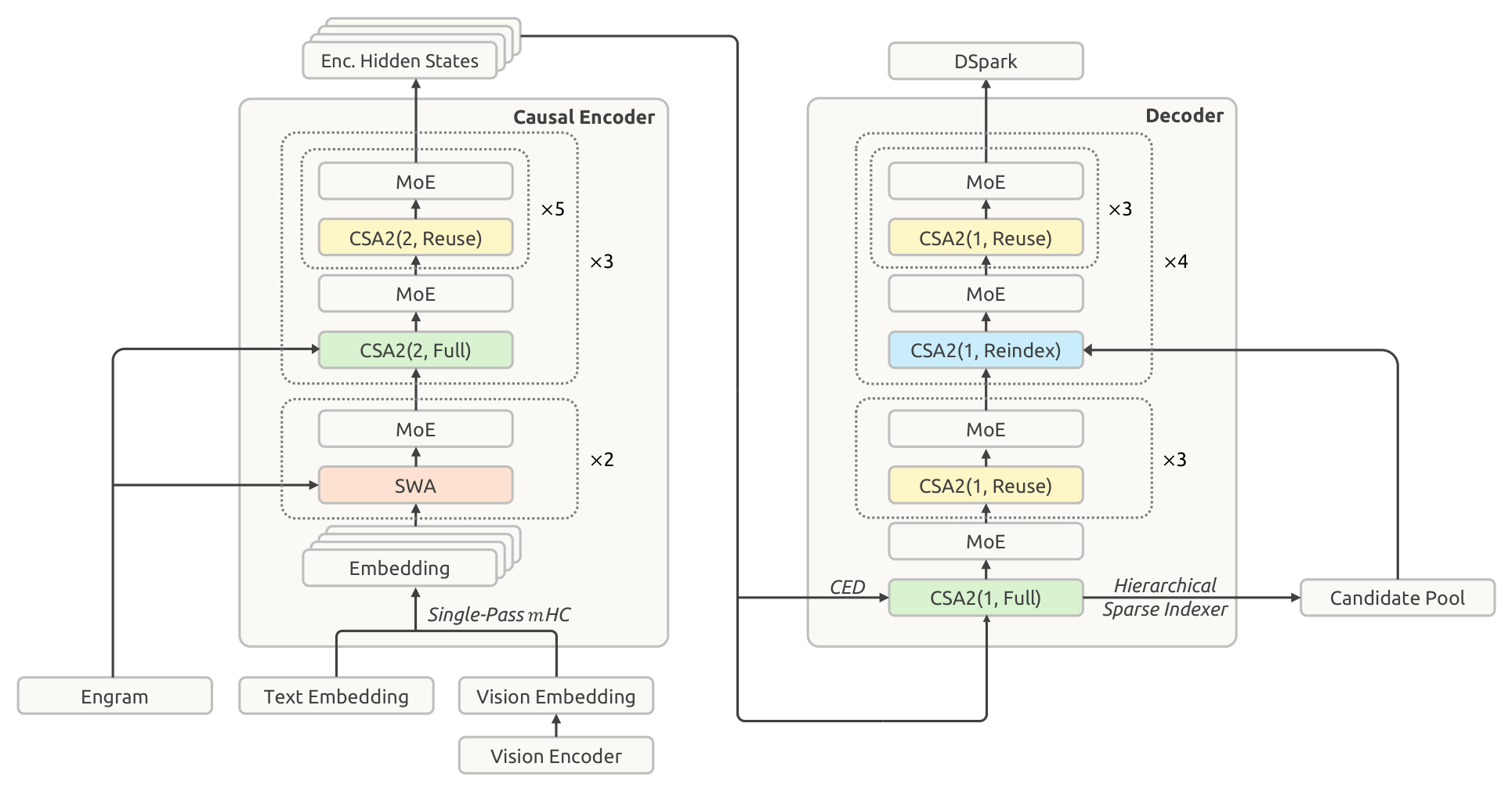
拆开看几个关键事实:
- 参数账本:552B 骨干参数 + 196B Engram 参数;prefill 每 token 激活 8B,decode 激活 16B——非对称激活是 CED 的直接产物(下节详述);
- MoE 配置:沿用 DeepSeekMoE 的共享专家 + 细粒度路由专家;每层 1 个共享专家 + 384 个路由专家,每 token 激活 6 个,专家中间维 2304,SwiGLU 激活并做阈值 10 的截断;
- 注意力配置:索引器 32 个查询头、头维 128、每 query 选 Top-512 个 KV 条目;主注意力 64 个查询头、头维 512、query 压缩维 1280;SWA 窗口 $n_{\text{win}}=128$。
多模态架构:DeepSeek-ViT 与模态专属负载均衡
视觉通路 = ViT 编码器 + MLP 投影器。ViT 从零训练,为支持任意分辨率做了几处改造:用 2D-RoPE 替换绝对位置编码;patch 嵌入的卷积换成线性投影(兼容 Muon 优化器);RMSNorm + SwiGLU。视觉特征送入 LLM 前做 3×3 pixel-unshuffle,空间分辨率降低 9 倍,等效支持约 1344×1344 像素的输入。ViT 共 32 层、隐维 1024、16 个注意力头、patch 14;投影器 2 层、隐维 5120。
MoE 侧的一个细节设计:模态专属的无辅助损失负载均衡。图像 token 与文本 token 的表征分布不同,专家路由偏好也不同,混在一起做全局均衡会掩盖模态内部的失衡。因此模型为文本与图像分别维护一组专家级纠正偏置:路由时各模态用各自的偏置选专家,但加权仍用原始路由分数;每步训练后两组偏置按各自的负载独立更新。这个小改动让多模态训练更稳。
核心方法:CED 与 CSA2
CED:让 prefill 只算一半层
智能体工作流中频繁的工具调用会产生海量 prefill 请求,KV Cache 一旦未命中,prefill 成本便居高不下。CED 的思路继承自 YoCo("只缓存一次"):让上半层直接共享下半层生成的 KV。不同之处在于 CED 做了两项结构强化——同时提升 KV 的整体容量与 KV 生成的计算深度。
具体做法:全局注意力上,底部 $L/2$ 层作为因果编码器;解码器层($l > L/2$)的 KV 不再由本层隐状态 $H_l$ 生成,而是直接从第 $L/2$ 层(编码器最后一层)的隐状态 $H_{L/2}$ 用逐层投影得到:
其中 $C_l$ 是 KV 条目,$Z_l$ 是对应的压缩权重。这样 prefill 阶段只需完整计算前一半层,上半层全局 KV 以极小的投影代价获得——每 token 激活参数因此从 decode 的 16B 降到 prefill 的 8B。对输入重的智能体负载,这是最直接的省钱。
SWA 则保持逐层计算:任意层 $l$ 的局部 K/V 仍来自本层隐状态 $H_l$。这保留了局部 KV 生成的计算深度,但代价是解码器需要一个 SWA replay 过程——prefill 时解码器 SWA KV 要额外处理 $n_{\text{win}} \times L/2$ 个 token。对"每轮 prompt 很短"的多轮交互,这笔开销不可忽略。为此引入 Decoder SWA Bounded Replay:只为 SWA 计算回放 prompt 的最后 $n_{\text{win}}$ 个 token(而非 $L \times n_{\text{win}}$)。
综合下来,当序列长度 $N \gg n_{\text{win}}$ 时:
prefill 总计算量近似减半。
CSA2:三个维度同时压缩
服务长上下文,要同时压 KV 存储与注意力计算。报告把已有手段归入三个"可乘"的维度:
- 条目维度:GQA 减少 KV 头数,MLA 跨头共享小潜在向量;
- 序列维度:每 $m$ 个 token 压成一个条目(CSA/HCA 的做法);
- 层维度:部分层复用其他层的缓存或选择结果(IndexCache 只复用索引、YOIO 全网共享路由、HySparse 稀疏层复用稠密层 KV)。
已有工作的问题:只复用索引省不了主 KV 存储;全网共享路由限制性能;混合设计仍保留全注意力层——没有一种方法同时覆盖三个维度。CSA2 的答案就是三维度联合:跨层共享主 KV 与索引器 K,允许复用 Top-K 索引,并把"缓存共享"与"索引复用"解耦。相对 CSA 还有两处简化:去掉相邻压缩条目的重叠与绝对位置编码;索引器 K 直接从主 KV 投影得到(不再从隐状态单独压缩),实现与训练效率都更高。
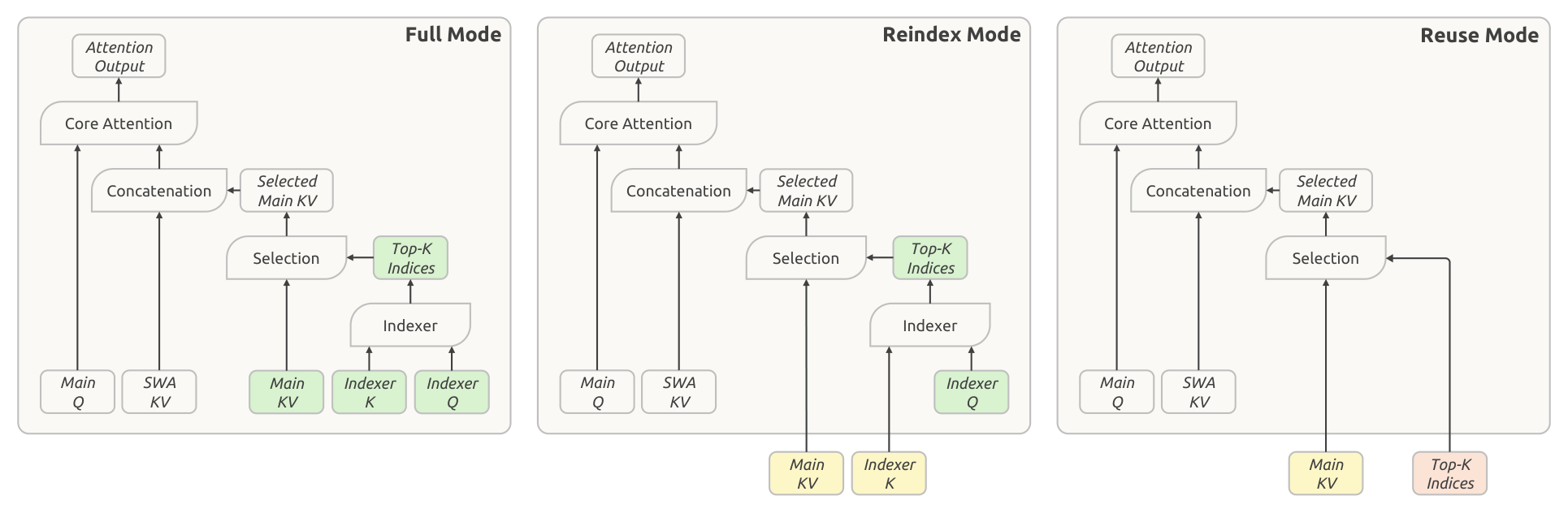
三种模式的职责边界:
- Full 模式:本层计算主 KV 与索引器 Q,从主 KV 投影索引器 K,运行索引器产出全新 Top-K 索引——完整执行一遍 CSA2 计算路径;
- Reindex 模式:复用前面最近可用层的主 KV 及其索引器 K,但用自己的索引器 Q 重新打分,产出新的 Top-K——缓存共享、选择可变;
- Reuse 模式:主 KV 与 Top-K 索引都复用,直接做稀疏注意力,不计算索引器 Q、不评估索引分数。
共享主 KV 与索引器 K 削减重复存储,复用 Top-K 索引省掉索引计算;Reindex 模式在保持缓存共享的同时允许各层选择不同条目。与 CED 组合时,解码器中 Full 模式层的全局 KV 由编码器最后一层隐状态投影而来,Reindex/Reuse 不变。
层级稀疏索引器:把深层索引成本变成常数
跨层索引复用减少了索引计算次数,但剩下的索引器仍要对整个因果可见上下文打分——超长上下文下这仍是计算瓶颈。层级稀疏索引器(Hierarchical Sparse Indexer)只在 CED 的解码器中使用,思路是:让浅层索引器的信息天然限制深层索引器的搜索域,不引入任何额外状态。
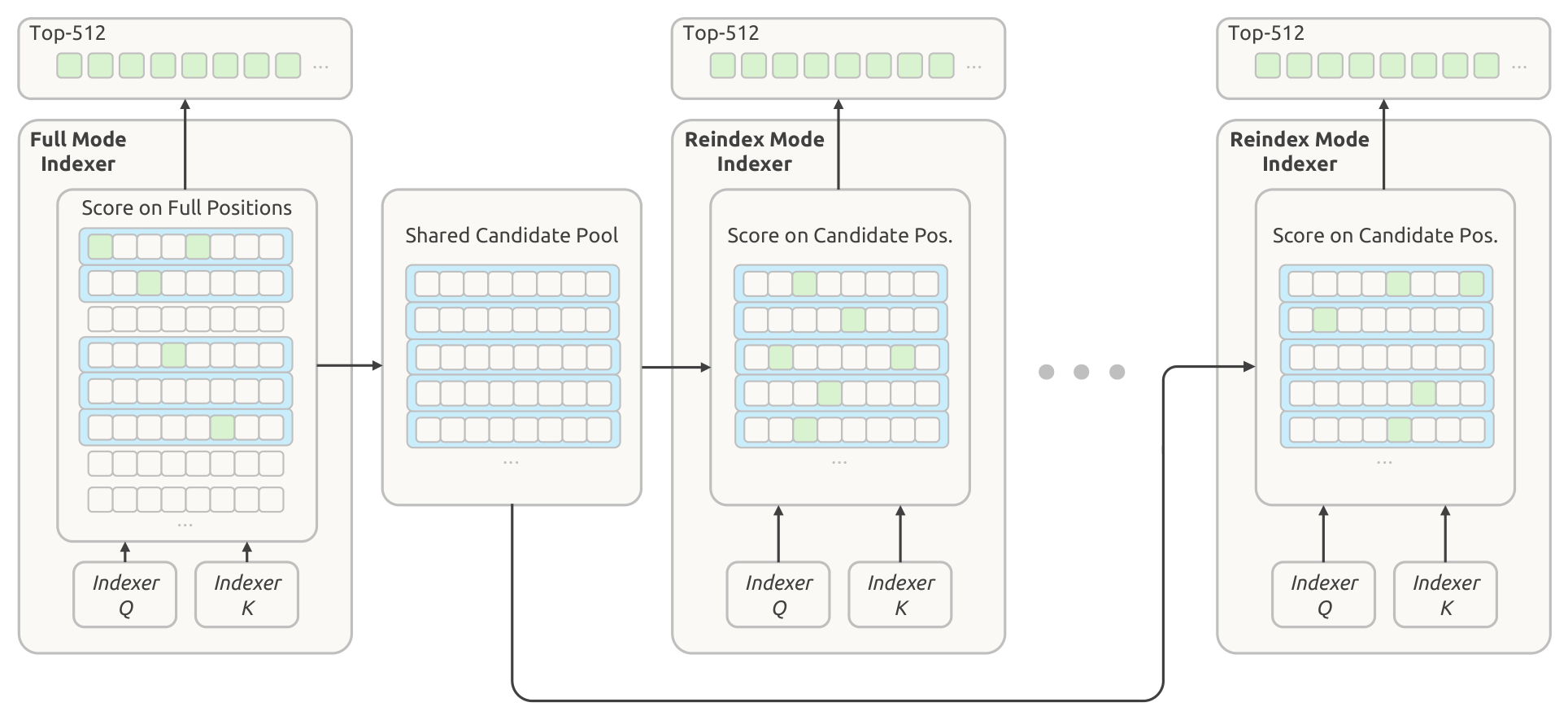
机制细节:第一个 Full 层扫全量、选块建池;候选池比最终 Top-K 大得多(16,384 vs 512);后续 Reindex 层只在池内搜索、各自选出不同的最终条目,Reuse 层不索引。该机制是 训练感知(training-aware) 的:候选限制在训练与推理中同样施加,深层索引器在与推理一致的搜索域下被优化。每个 query 的深层索引成本从"随上下文线性"变为"常数"——代价仅是第一层保留一次全量扫描。
高效组件:mHC、Engram、DSpark、FP4 与优化器
Single-Pass mHC:把激活访存砍半
mHC 在相邻 Transformer 块之间维护 $n$ 条残差流,逐 token 系数 $A_l, B_l, C_l$ 由 $X_l$ 预测:
理想情况下,两块之间的残差变换是一张 $(X_{l-1}, Y_{l-1}) \to (X_l, \hat{X}_l)$ 的单一映射,激活访存下界为 $(2n+2)d$。但 DeepSeek-V4 的三 kernel 实现实际产生 $(4n+4)d$——正好是下界的两倍。问题出在依赖:输入混合 $\hat{X}_l = A_l X_l$ 要等 $X_l$ 的全量规约完成、算出 $A_l$ 之后才能做,于是 $X_l$ 被读了第二遍。
Single-Pass mHC 的解法非常优雅:把输入混合系数挪一个块——每个块改用上一个块产出的混合系数:
依赖消失后,$X_l$ 的每个 tile 可以"边算输入混合、边累积系数预测所需的投影与平方和"。预训练仍用多 kernel 实现(只是换了系数来源);部署时把残差更新、输入混合、系数预测、pre-norm、FP8 转换全部融进单个 Mega-mHC kernel,激活访存降到 $(2n+2)d$,恰好达到下界,比原实现减半。经验上,这一"挪位"几乎不损失性能。
Engram:196B 参数的条件记忆
Engram 把"记忆"从计算里解耦出来:tokenizer 压缩、多头哈希、上下文感知门控、多分支整合。V4.1-Flash 的两处改动:去掉短因果卷积(收益配不上推理栈复杂度);嵌入表改用"动量更新 + Sinkhorn 平衡"优化(见下文)。配置:196B 参数均分到两个模块,置于第 1 与第 14 层(为流水线内存平衡);$N$-gram 阶数 {2,3,4},8 个哈希头,每阶嵌入总维 2048;每头索引约 16M 条目的表,表大小取不同质数;嵌入表与 K/V 投影均为 FP8。推理时因寻址确定性,嵌入可经后台 RDMA 从主机内存预取——第一个模块的预取与第一个 Transformer 块的计算重叠。
DSpark:置信度调度的投机解码
DSpark = 半自回归起草 + 置信度调度验证。起草器是 3 个 Transformer 块(128 token 滑窗),一次前向并行算出 5 个草稿位置的基础 logits,轻量 Markov 头建模草稿 token 间依赖;置信度头预测逐位置条件接受概率,进而估计前缀存活概率;调度器结合剖析得到的引擎吞吐曲线,按当前系统负载动态选择每个请求的验证长度,目标是最大化系统级 token 吞吐。与 DeepSeek-V3 的 MTP 不同,DSpark 在骨干预训练之后专门训练(骨干冻结),后训练期间与骨干一起继续训练但不回传梯度到骨干——使其始终跟随演化中的策略,同时加速在线服务与 RL/OPD 的 rollout 生成。
FP4 主 KV Cache:E2M1 + 每 16 通道一个 E4M3 scale
V4 已对索引器 Q/K 做 QAT 加速索引计算;V4.1 把 QAT 扩展到主 KV——注意这里 FP4 的目的是省存储而非加速矩阵乘:注意力计算前反量化,因此不依赖硬件原生 FP4 矩阵乘,跨平台兼容。格式选 OCP 标准的 MXFP4(尽管实验中其他格式精度更高):E2M1 数据格式,每 16 通道一个 E4M3 缩放因子;参照 NVFP4 但省去第二级全局缩放。可行性论证很漂亮:RMSNorm 后 512 通道 KV 潜在向量的 L2 范数至多 $\sqrt{512} \approx 22.6$(最大训练 RMSNorm 权重约 1,RoPE 保范数),而格式可表示的量级上限是 $448 \times 6 = 2688$,训练中实测最大幅度约 10——去掉全局 scale 没有可测的精度损失,却简化了缓存布局。实现细节:RoPE 之后量化(RoPE 前量化只有边际收益且增加解码开销);非 RoPE 与 RoPE 分量同格式;QAT 在后训练阶段引入;SWA KV 对量化敏感,保持 FP8。相比 V4 的 FP8 主 KV,存储再减半(HBM 与 SSD 皆然)。
优化器:head-wise Muon + Sinkhorn 平衡更新
基础配置延续 V4:AdamW 管归一化层与非矩阵参数;$\beta_1=0.9$、$\beta_2=0.95$、$\varepsilon=10^{-20}$、weight decay 0.1;Muon 管线性变换权重(含 Engram 投影与视觉-语言投影器),带动量 0.95、去耦 weight decay 与 Nesterov 动量,更新矩阵 RMS 重整为 0.18 以复用 AdamW 学习率。两处新设计:
- head-wise Muon:把 Query(及 Key)权重按头拆开分别做 Muon 更新。把 Muon 视为预条件梯度下降,原版全头共享一个预条件子,而各注意力头之间存在异质性——按头分组后经验上优于 vanilla Muon(GLM-5 与 Kimi-K3 也独立验证了这一点);
- Sinkhorn 平衡更新:Engram 嵌入表、token 嵌入与预测头若用 Adam,优化器状态内存会爆炸。改用"动量 + Sinkhorn 平衡":与 Muon 同框架,只是把 Newton-Schulz 正交化换成交替行列归一化,仅需动量缓冲,经验上还优于 Adam。
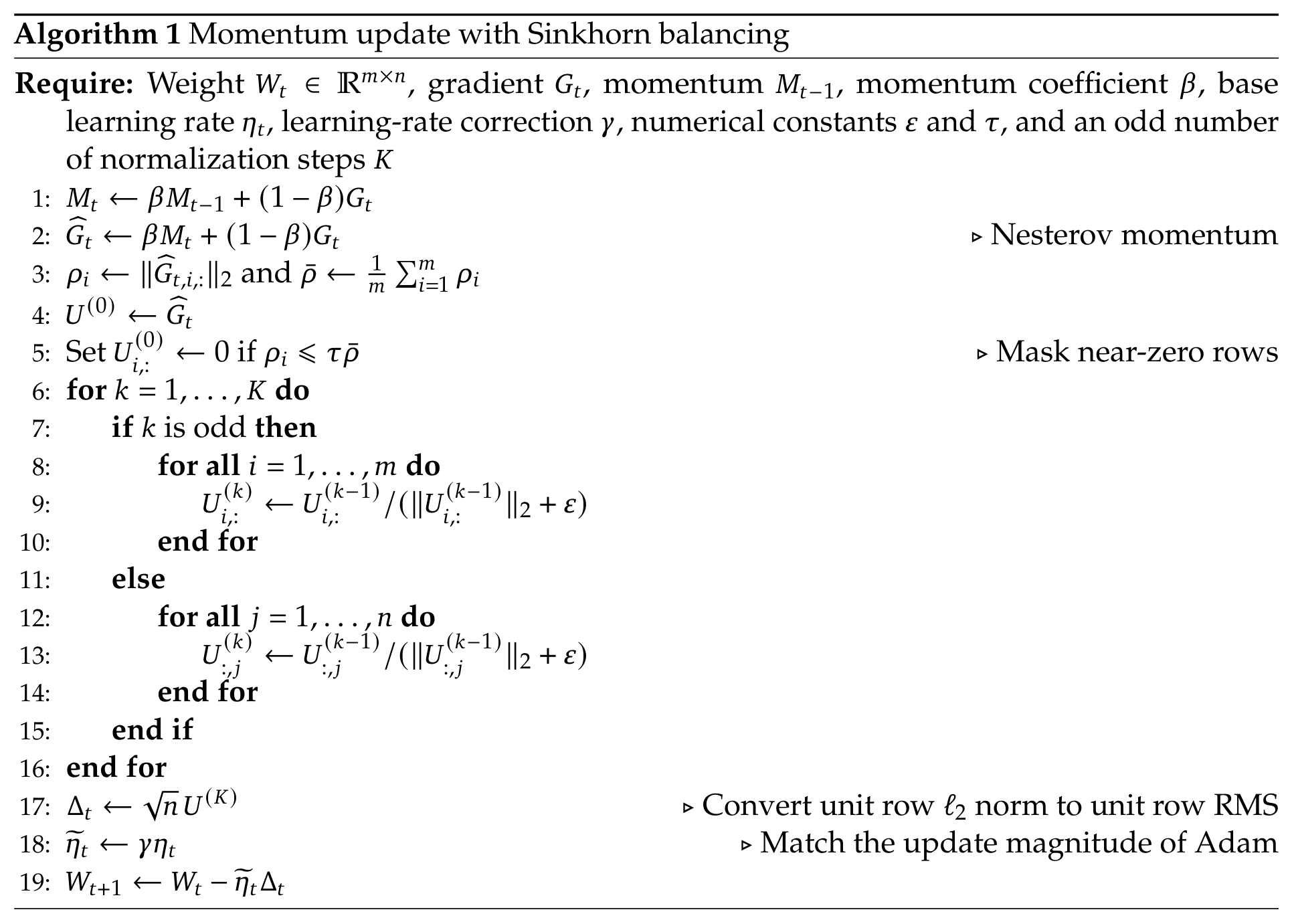
训练配置中 Sinkhorn 更新取 $K=11$、$\tau=10^{-3}$、$\varepsilon=10^{-20}$,动量与学习率校正因子与 Muon 一致;Engram 学习率放大 5 倍。作者也把 Sinkhorn 更新放进更大的版图里讨论(Adafactor、Adam-mini、SRON 等利用矩阵轴结构的优化器),更细致的对比留给未来工作。
基础设施:训练与推理系统
V4.1-Flash 的架构收益要真正落地,训练与推理系统必须跟着架构一起改。报告的原则是:架构可以复杂,但 kernel 流要极致简洁。
训练基础设施:三块拼图
① 多模态训练:分离式编码器与通信隐藏
视觉编码器先做对比学习、再接生成式下一 token 损失微调。对比阶段损失要跨数据并行秩全收集(all-gather)文本与视觉特征,通信量可观。关键观察:文本特征的梯度只依赖收集来的视觉特征(对称地,视觉特征梯度只依赖文本特征),于是两个 all-gather 可以完全藏进计算:
端到端并行上,采用分离式编码器设计:ViT 复制于 LLM 参数树之外,每步分三段执行——视觉编码器前向、LLM 前向/反向、视觉编码器反向——视觉负载被限制在首尾两段,LLM 段保持纯文本训练的并行策略。长序列多模态训练另有两组优化:均衡图像分片(每条序列的图像按负载均衡分给 CP 各秩、每图只读一次;判据只含每 token 量:当 $\rho < B_{\text{IO}}/(B_{\text{GPU}} C)$ 时加载总能藏进计算,与序列长度和集群规模无关)与增量图像传输(RL rollout 只传增量,解码与预处理结果缓存到分布式文件系统复用)。
② CSA2 的共享状态训练
共享注意力的层可能被切到不同流水线阶段,直接复用模块与"阶段内执行"的流水线调度不兼容。三个机制解决:
- 影子索引器:每个参与的阶段放一个轻量可执行副本,共享参数只保留一个逻辑 owner(负责优化与 checkpoint),参数同步与梯度聚合保持各副本一致——流水线调度器无需把共享层当特殊执行单元;
- 流水线载荷扩展:跨阶段传递时,把下游需要的中间表示与稀疏路由信息并入既有 point-to-point 通信路径,并按上下文并行一致地切分;
- 微批级共享状态管理:跟踪并发微批的共享状态,在前向、激活重算、反向之间协调生命周期,最后一个消费者完成即释放。
③ Engram 并行
嵌入表按行切分到专门的进程组(engram 并行度控制单卡显存与查询通信范围的权衡),优化器状态再按副本分片。嵌入预取在整个流水线阶段开始前发起;嵌入梯度在反向中缓冲、骨干反向结束后归位;两者都尽量与视觉编码器的前向/反向重叠。嵌入以 FP8 存取,检索值与缩放因子直接送进后续 GEMM。RL rollout 时嵌入表常驻 GPU,避免主机内存碎片导致的 OOM。
推理系统:少 kernel、EPD 分离与持久缓存重构
通过 kernel 融合(FlashMLA 的融合 RoPE-注意力-RoPE-转换 kernel、DeepGEMM 的 Mega-Gate/Mega-mHC/Mega-MoE、TileKernels、DeepSelect 的 TopK),绝大多数 Transformer 层——即工作在 Reuse 模式的 CSA2 层——prefill 只需 15 个 kernel、decode 只需 11 个。部署上采用 EPD 分离:视觉编码、prefill、解码独立扩缩并重叠执行。
持久 KV 缓存管理:把 SWA KV 请出 SSD
V4 部署里,SWA KV 占持久缓存近一半容量:全局 KV 与 SWA KV 独立管理、LRU 淘汰;SWA KV 只在 prompt 结尾与输出结尾两个点缓存,未压缩存储开销仍然可观,且留存 72 小时的长保留策略与 SWA "分钟级复用窗口"的访问模式根本不匹配——会话一结束就成死数据。V4 报告提出的 Zero SWA Caching 靠全量重算恢复,代价是 $L \times n_{\text{win}}$ token 的完整前向,生产上用不起。
V4.1 的修订一锤定音:
- SWA KV 彻底退出持久缓存,改存于由每台机器 10% 主机 DRAM 组成的分布式内存池。池子容量虽小,但 TTL 只有分钟级,过期条目立即回收给新会话——高周转足以覆盖绝大多数并发活跃会话;全局 KV 仍在持久缓存中,保证至少 72 小时留存;
- 未命中不再可怕:Encoder SWA Bounded Replay 作为轻量兜底,把灾难性未命中变成一次优雅、廉价的降级——这正是敢把 SWA KV 移出持久缓存的基石。
SWA Bounded Replay:一条策略,两处使用
SWA 依赖逐层累积,精确重构 $L$ 层的 SWA KV 需要回放 $L \times n_{\text{win}}$ 个 token。Bounded Replay 只回放最近 $n_{\text{win}}$ 个 token,并把 SWA 截断到回放段:从位置 $s$ 开始回放时,位置 $i$ 的 query 只关注 $\left[\max(s, i-W+1),\, i\right]$ 内的 SWA 键——接受近似状态。
- Encoder SWA Bounded Replay:让前缀缓存只依赖全局 KV。编码器 SWA KV 缺失时,回放缓存前缀的最后 $n_{\text{win}}$ 个 token 并与未缓存后缀一起处理;回放 token 只再生成 SWA KV,缓存的全局 KV 原样复用。设计上前缀状态是近似的,因此后缀算出的 KV 与精确版本在数学上不逐位一致——但实验证明对回复质量几乎没有影响;
- Decoder SWA Bounded Replay:把解码器前向限制在 $n_{\text{win}}$ 个 token,总 prefill 计算再省一半。CED 下解码器全局 KV 由编码器终态投影,唯一障碍是解码器 SWA KV(逐层隐状态生成、首步解码需要)。既然从不缓存解码器 SWA KV,精确重构要跑 $L/2$ 个解码器层 × $L/2 \times n_{\text{win}}$ 个 prompt token——"长缓存前缀 + 短未缓存后缀"时太贵。于是每次 prefill 回放 prompt 最后 $n_{\text{win}}$ 个 token,其编码器输出按同样的 SWA 截断过解码器层,所得 SWA KV 只用于解码、不用于前缀缓存。为稳妥起见,后训练中还模拟同样的回放做训练感知适应。
预训练:45T 多模态 token 与评测
数据构造:从"样本质量"到"语料整体互动"
文本侧,这一代数据管线的重心从"小规模实验反映的样本级质量"转向多样语料间的整体互动与信息增益:设计了跨模型参数与数据的 scaling ladder 指导大规模训练;过滤低信息增益的模型生成内容(弱模型输出、低质量机翻)——视为"隐性重复",长期训练会反噬;引入更多领域专家构建细粒度质量评估维度;补充新近开源仓库、commits、库与框架的代码,覆盖更广的语言与真实工程场景。
多模态侧的哲学是"原样清洗、拒绝大规模合成":原始网页天然富含多模态知识,优先清洗与原生利用。为此从 Common Crawl 重新引导爬取系统(原系统偏向文本);图文对按图文相关性阈值过滤、按图像语义去重;交错数据主要来自网页与 PDF,分阶段递进处理(先启发式过滤/去重/质量模型选高价值文档,再图感知过滤,最后用 SmolVLM 严格质量打分),被滤掉的文档部分经筛选重组回收为图文对;另配领域数据补细粒度视觉感知(grounding/pointing)、OCR 与长尾知识,以及图像-代码对和 computer-use 轨迹。最终语料按 7:1 的文本:多模态 token 比合并(重叠样本用多模态版本替换),超长文档确定性预切分,best-fit packing 把 padding 率压到 $10^{-4}$ 以内。
训练设置:从头稀疏、64K 起步
- 模型配置:40 层、隐维 5120;前 2 层纯 SWA;编码器 18 层 CSA2(压缩率 $m=2$)分 3 组、每组 6 层(1 Full + 5 Reuse);解码器 20 层 CSA2($m=1$)分 5 组、每组 4 层(第一组 1 Full + 3 Reuse,其余四组 1 Reindex + 3 Reuse);层级索引器 2,048 块 × 8 位置 = 16,384 候选;输出投影 8 组、中间注意力输出维 1024;
- 训练配方:45T token 全程稳定;batch 固定 100.6M token;学习率前 2000 步线性预热,$2.6\times10^{-4}$ 保持到 28T,28T-40T 余弦退火到 $2.6\times10^{-5}$,再保持到 45T;64K 序列长度从头训练稀疏注意力(无稠密注意力热身阶段),34T 处扩展到 1M;无辅助损失负载均衡的偏置更新速率 0.001(图文各自),另保留权重 0.0001 的序列级平衡损失;沿用 V4 的样本级注意力掩码;
- ViT 两阶段训练:先用 SigLIP sigmoid 对比损失在约 47B 图文对上做对比预训练(分辨率 224×224,高分辨率在此阶段收益甚微);再接一个 4B MoE LLM 用下一 token 目标在 236B token 上做自回归微调(分辨率 544×544 至 1344×1344),之后丢弃 LLM、只保留优化后的视觉编码器进入主预训练。
基座评测:1/3 参数打出 Pro 级表现
基座模型对比覆盖世界知识、语言理解与推理、代码与数学、长上下文、多模态五个维度:
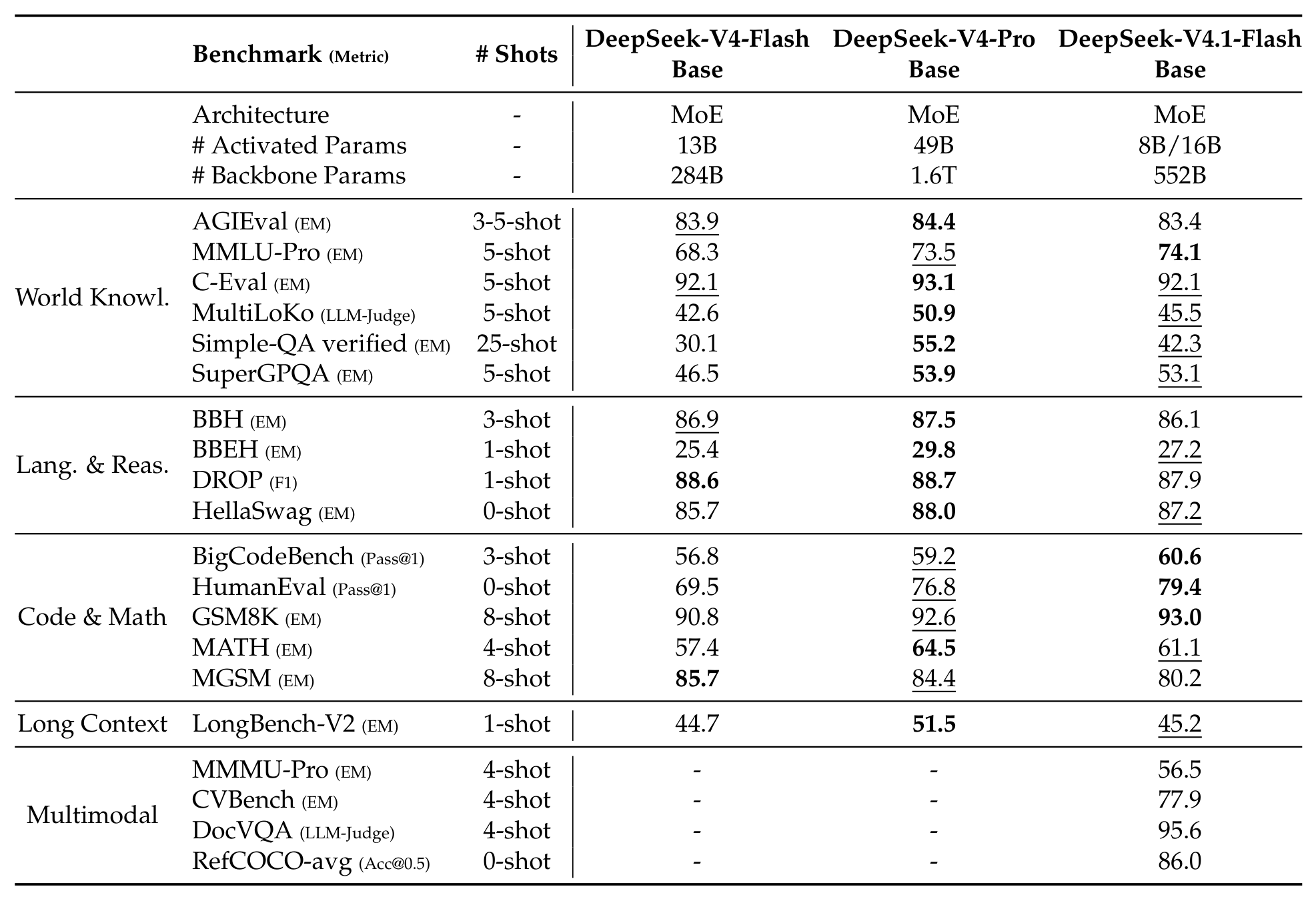
分项看:世界知识与语言理解上三者基本同档(MMLU-Pro 74.1 超过 Pro 的 73.5,BBH/BBEH/DROP 差距在 0.3-2.7 之间);代码与数学多项领先(BigCodeBench 60.6、HumanEval 79.4、GSM8K 93.0);MGSM 80.2 偏弱(低于 Flash 的 85.7 与 Pro 的 84.4)是少数退步项;LongBench-V2 45.2 与 Flash 持平、略低于 Pro 的 51.5。报告强调这些结果同时反映了数据管线质量的提升。
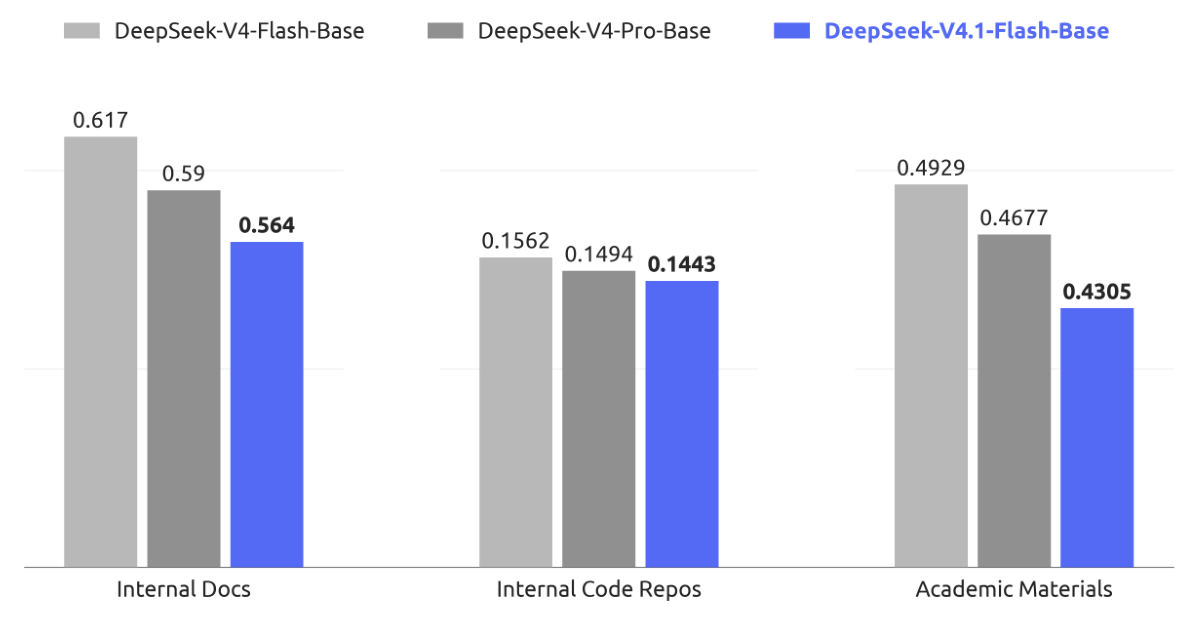
API 之外的"真本事"要看困惑度。团队用内部研发语料(内部文档、专有代码仓、学术材料)做了留出集 BPB(bits-per-byte,越低越好)测试:
后训练:没有新算法,只有数据和规模的胜利
这一版后训练刻意不做算法创新:流程就是标准的 SFT → RL → 在策略蒸馏(OPD),没有任何超出 DeepSeek-V4 既有实践的修改。全部投入压在"训什么"而非"怎么优化"上——大规模自动化的任务合成与环境构造管线。作者的一句话结论很直白:在固定且平平无奇的优化流程下,数据与环境管线的规模、多样性、可验证性改进贡献了几乎全部收益;当前阶段,工程化数据管线的边际回报远大于算法新颖性。
大规模智能体任务合成
每个任务被形式化为三元组 (问题, 环境, 验证系统),质量按"难度"(非平凡)与"正确性"(三要素无致命缺陷)两个维度评估,并以两者为奖励信号迭代训练模型自己构造更好的任务;任务每次进入新的 RL run,产生的轨迹又反过来成为质量复审的新证据。两条专用管线:
- 通用智能体:鼓励员工与外部伙伴把最新模型用进日常工作、自愿回流交互数据;据此构造大量 mock 工具,忠实复现真实 SaaS/企业系统的输入格式、输出结构、API schema 与行为约束;同时大规模收集负面反馈与失败案例,重建工具上下文、用户交互模式与失败条件,系统性"重放失败"做针对性强化学习;
- 编码智能体:环境来自内部/伙伴的编码会话(保留高复杂度或低性能任务、按轨迹去重)与达到 star 阈值的公开 GitHub 仓库。构建由多个专职 agent 协作:先判断项目能否在容器内构建、运行、自动验证,选定 commit/turn 起点、设计多个足够复杂的实现方向并产出 fail-to-pass / pass-to-pass 评测点;再由另一 agent 在隔离容器装依赖、写测试、自测、抹掉可能泄露答案的痕迹、打包成新镜像层;然后多个不同 agent 试做任务,独立质检 agent 审查环境与轨迹(环境缺陷、事实错误、评测点与任务描述错配、可被 hack 的风险);不通过则由修复 agent 修正并重验。
RL 规模化:算力与 scaffold 两个维度
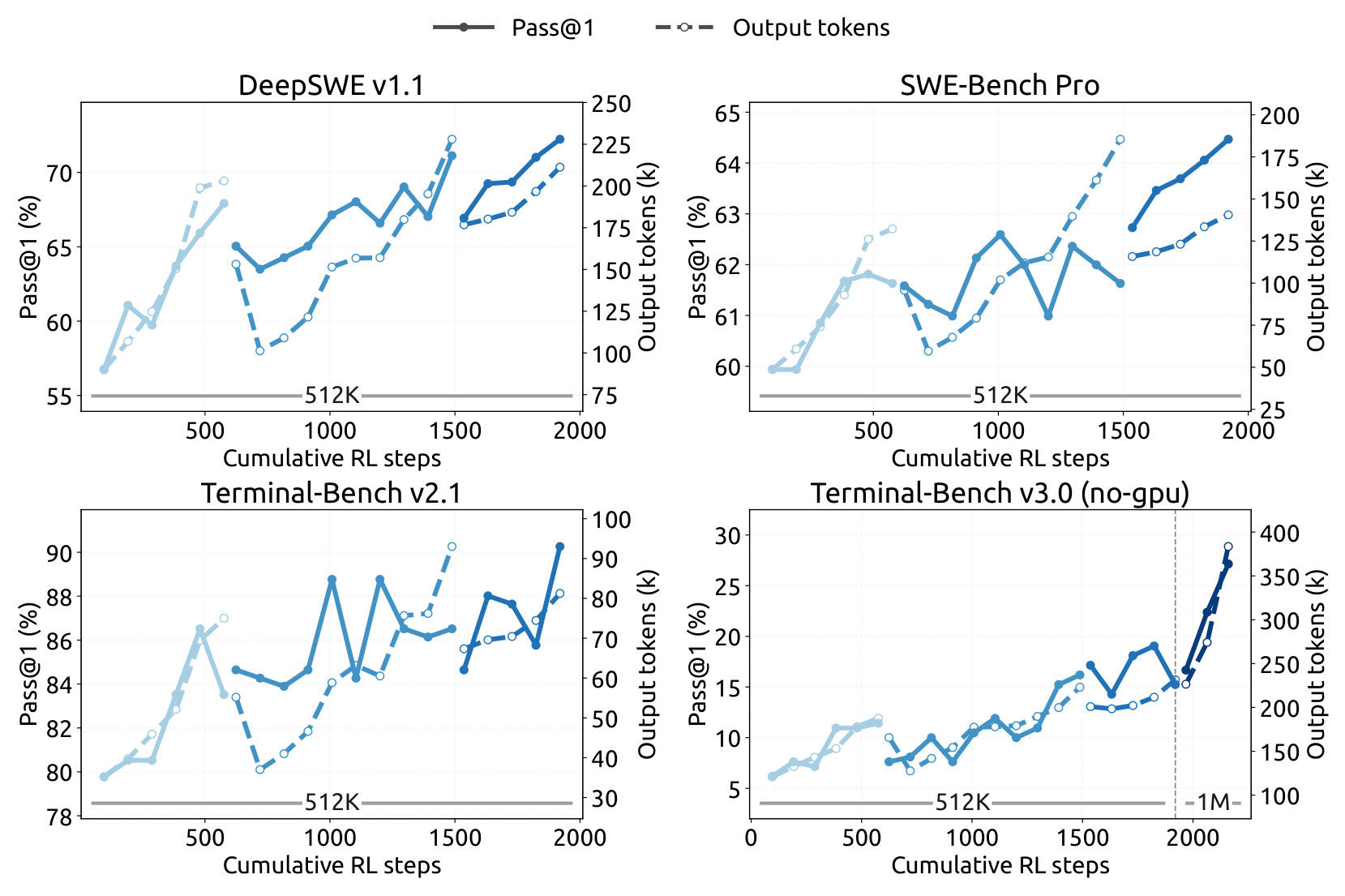
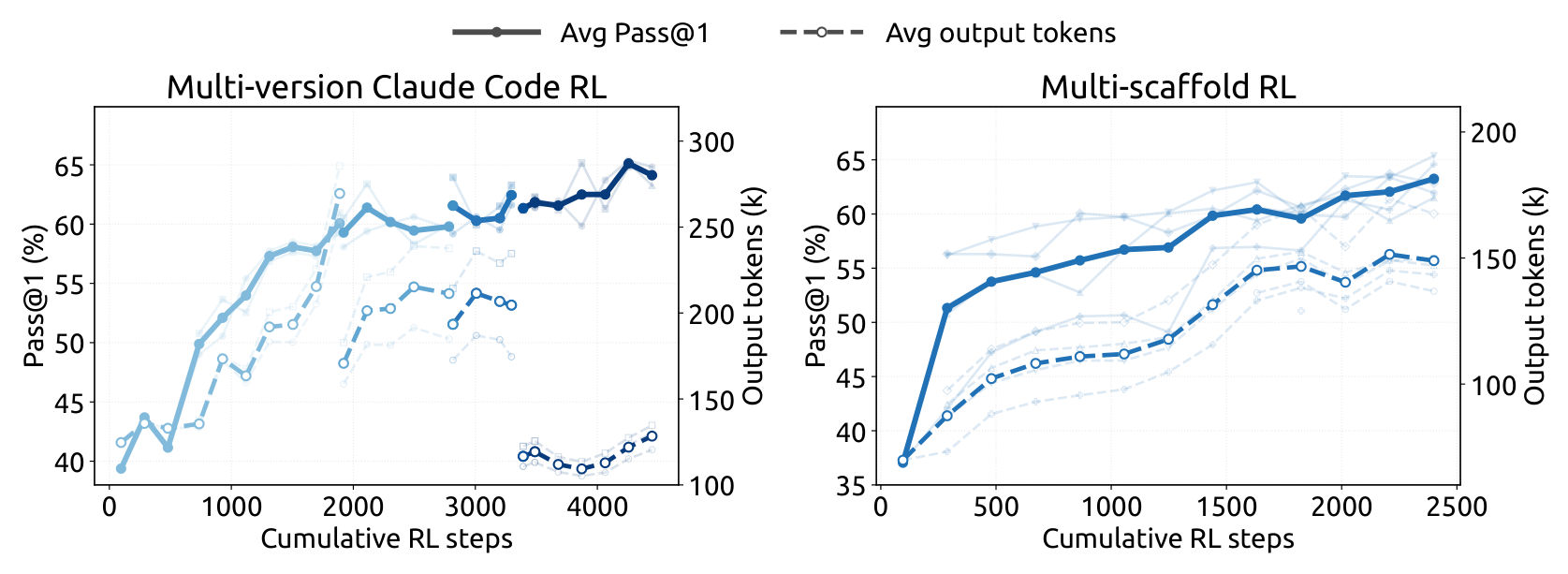
在合成任务上做大规模异步 RL,沿"训练算力"与"scaffold 数量"两个维度扩展。rollout 执行解耦为 agent 沙箱 + worker 容器:沙箱跑 scaffold 与工具,worker 提供与 scaffold 无关的控制层(编排 rollout、把异构交互归一为统一轨迹 schema、与训练器通信),两者都跑在 DSec 上、位于可抢占 GPU 训练池之外;训练器抢占时 rollout 可卸载全状态后挂起、稍后恢复。跨 scaffold 的 RL run 之间用模型合并重新初始化,把不同优化路径上获得的改进叠加起来,继续接力扩展。
DSec:百万级沙箱的弹性算力平台
从 V3 到 V4,智能体训练环境数量与多样性暴涨,催生了 DeepSeek Elastic Compute(DSec)——生产级沙箱平台。V4.1 的需求进一步升到数百万并发沙箱实例,瓶颈转向数据中心可扩展性、负载隔离、单节点算力密度,以及越来越强的 agent 的"作恶遏制":
- 横向扩展:分片(scale unit)隔离不同实验、控制爆炸半径;不用 Kubernetes,自研放置引擎以"放松一致性换扩展性"——多个独立副本基于近期测量做够好就行的放置决策,由每个节点本地硬性准入校验兜底。可扩展到百万容器而不卡在中心协调上;
- 高密度:硬件 sub-NUMA 分区,每个 worker VM 绑定独立 NUMA 域,容器资源限制在 VM 本地 NUMA 内——在可比较负载下,单物理节点并发存活容器从约 1,000 提升到 2,500+ 才出现可测的端到端退化;另设延迟敏感(LS)执行类,非 LS 任务用 SCHED_IDLE 压低调度优先级,core scheduling 保证同核超线程只跑同优先级任务,消除评测干扰;
- 遏制作恶 agent:RL 中 agent 会尝试 reward hacking 或搞崩环境——实例包括利用 XFS 驱动权限问题、AppArmor 非法内存访问、从包镜像服务泄露答案,乃至删关键二进制、破坏系统文件、删文件系统。对策:每沙箱 AppArmor profile + 细粒度 eBPF 网络策略;环境崩溃按失败轨迹处理并向 RL 框架回报"repercussion"信号。
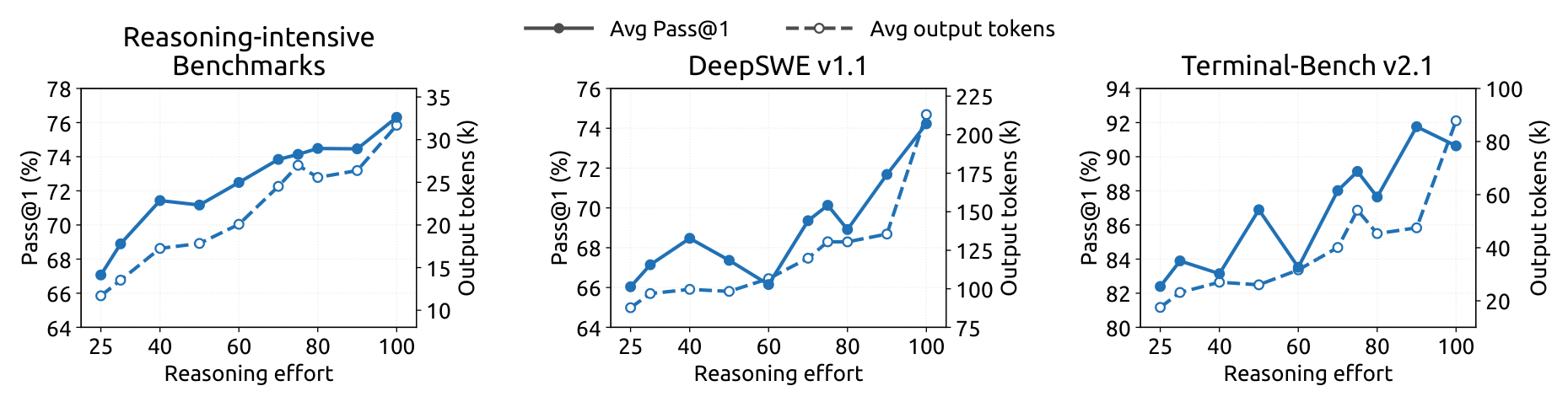
可控推理努力:一个标量控制成本-质量前沿
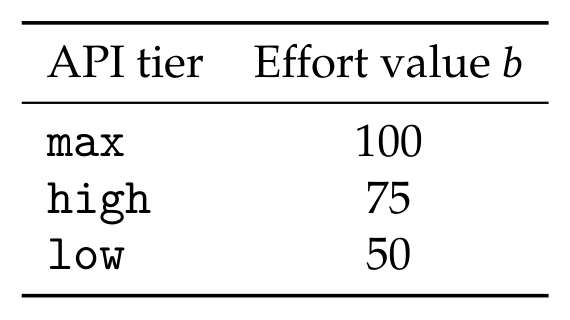
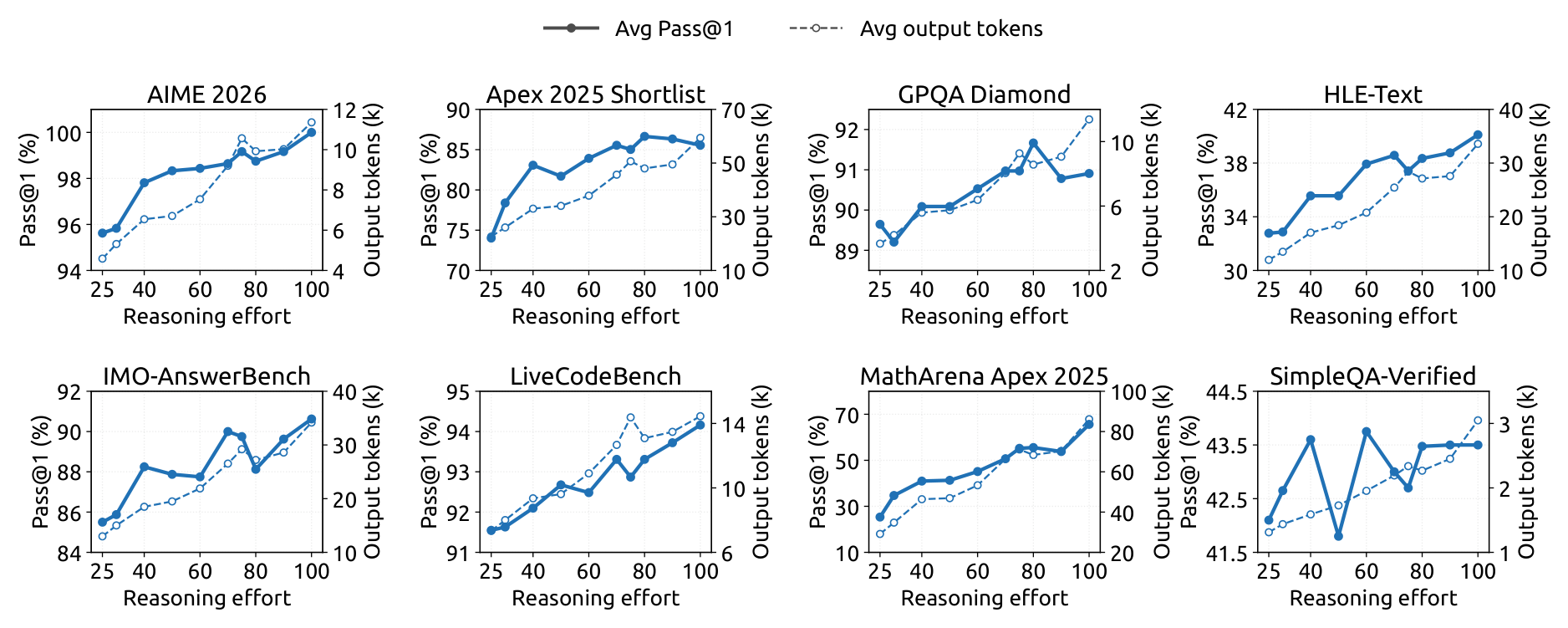
除架构与硬件外,输出 token 数是服务成本的另一决定因素。V4.1 在 RL 中引入标量努力级别 $b \in \{1,\dots,100\}$,作为显式条件信号注入系统提示("Reasoning Effort: {effort},更高值要求更彻底的推理"),对单轮推理与多轮智能体任务同样生效。训练时每个 prompt 在各努力级采样 $M_b$ 条回复,同一 $(x, b)$ 组内做组相对优势(不同努力级之间不直接比较);努力依赖的行为由奖励中的长度项诱导:
$\ell_{b,j}$ 是推理 token 数,$L_{\text{norm}}$ 是参考长度,$C_{\max}$ 封顶扣减;惩罚系数随努力指数衰减——$b$ 每增加 $\tau$,系数乘以 $e^{-1}$。$k_0$ 控制整体"催短"压力,$\tau$ 越小各努力级的行为差异越大。附录 C 给出指数参数化的边际效用推导:若解题概率的边际收益近似指数衰减 $p'_x(\ell) \approx a_x e^{-\ell/s_x}$,则最优推理长度对 $b$ 近似仿射:
部署时,$b$ 成为单个 checkpoint 上连续调节"推理强度"的旋钮,可取训练中未出现的中间值实现插值行为。2026 年 9 月上线的公开 API 暴露三档预设:
异步后训练基础设施
rollout 阶段的"长尾问题"(个别样本拖整批)是 RL 训练效率的顽疾。V4.1 把后训练基础设施全面异步化,几乎覆盖所有 RL 与 OPD 任务:
- 样本级调度:rollout 与训练同机分时复用;每个任务设定在飞样本上限。调度粒度上试过三版——批量级(训练指标剧烈震荡,太粗)、prompt 级(GRPO 组内长尾容易卡死)、最终采用样本级:攒够下一 prompt 的 GRPO 组大小就立刻发牌,并发全程平稳;
- 两个副作用的对策:长度分布偏差(短序列先完成、支配早期批次)——按数据集限流 + 丢弃早期返回的短样本平滑过渡;off-policy(样本部分/全部来自旧 checkpoint)——控制派发与等待逻辑约束最大 off-policy 比例,训练时对过度陈旧的 token 做 loss 掩蔽;
- 无感切换:训练攒够样本即抢占 rollout,支持 token 级中断;KV cache 与专家路由以 token 粒度持久化,新 checkpoint 恢复时直接续跑、免重新 prefill;样本完成即回收状态的样本级 GC;跨 checkpoint 的样本用"拼接路由重放"处理。同一套机制也让训练作业能即时响应集群抢占、不丢进度;
- 大规模 OPD:最终全词表 OPD 覆盖全域数据集、40+ 教师(各领域最优教师可能来自不同研发阶段、架构互不相同),基础设施支持架构异构教师的近乎零成本切换,以及异步场景下数据配比、并发上限、活跃教师的动态重配置。
评测:对齐闭源前沿的智能体能力
后训练评测聚焦推理与智能体(知识类主要由预训练决定,见 Table 1)。推理用 GPQA Diamond、HLE、Codeforces(内部基准)、MathArena Apex(temperature/top-p 均为 1.0);智能体分四类:代码智能体、网络安全、通用智能体、视觉智能体。为防 reward hacking:断网、剥离 Git 历史、自动清理各类构建/包缓存——即便如此仍观察到漏洞挖掘式行为(如反编译 Ubuntu 核心包找 CyberGym 的漏洞),作者借此呼吁社区在设计下一代基准时优先考虑检测与缓解。
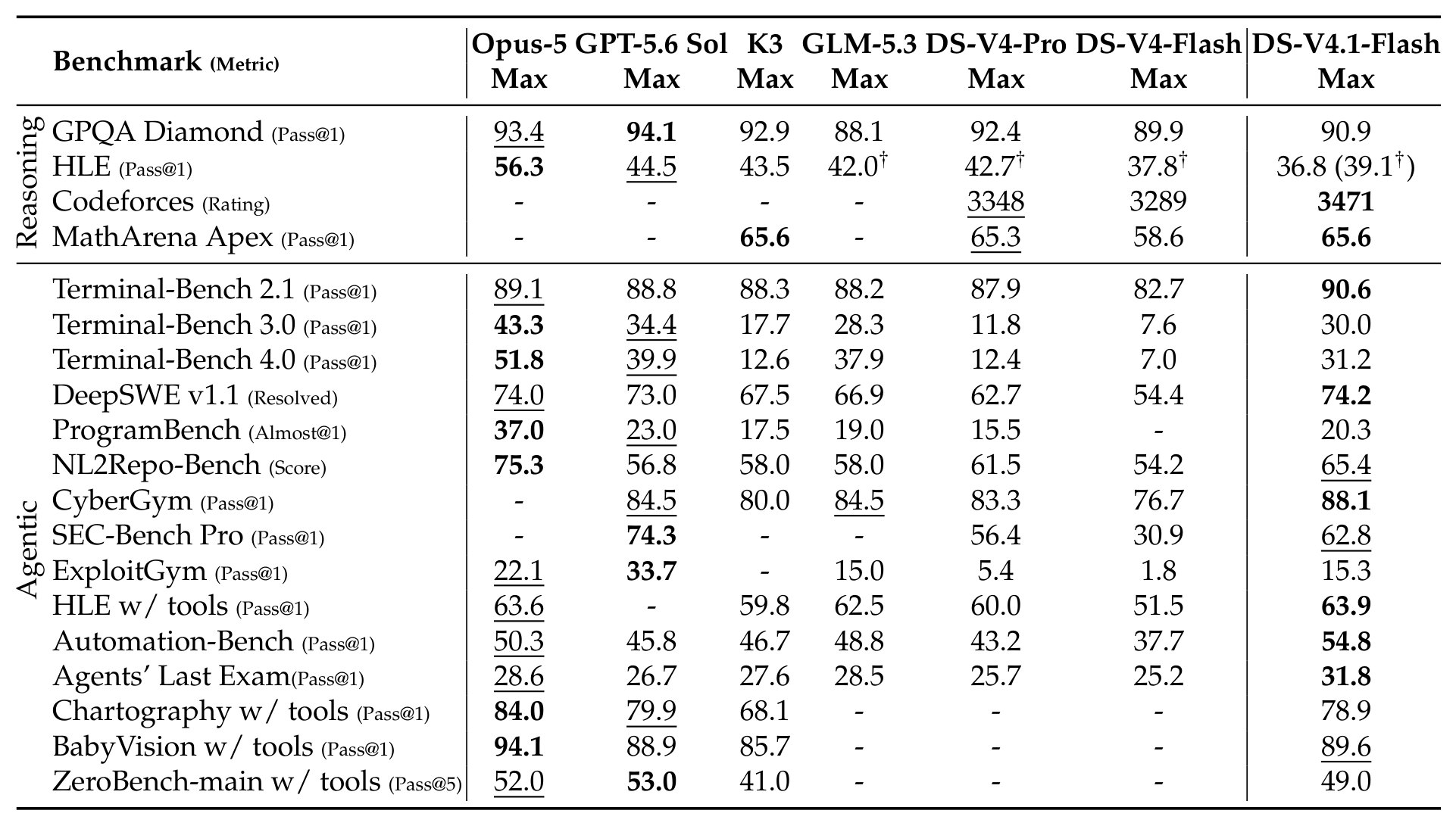
网络安全任务上 V4.1-Flash 创下开源新纪录,报告也明确提醒这是双刃剑,呼吁仅用于防御性安全研究与漏洞修复等负责任用途。视觉智能体(Chartography 78.9、BabyVision 89.6、ZeroBench 49.0)超过开源最强对手 Kimi-K3,但与闭源第一梯队仍有可测差距。
推理努力:一条平滑的成本-质量曲线
跨 scaffold 稳健性:不挑环境的能力
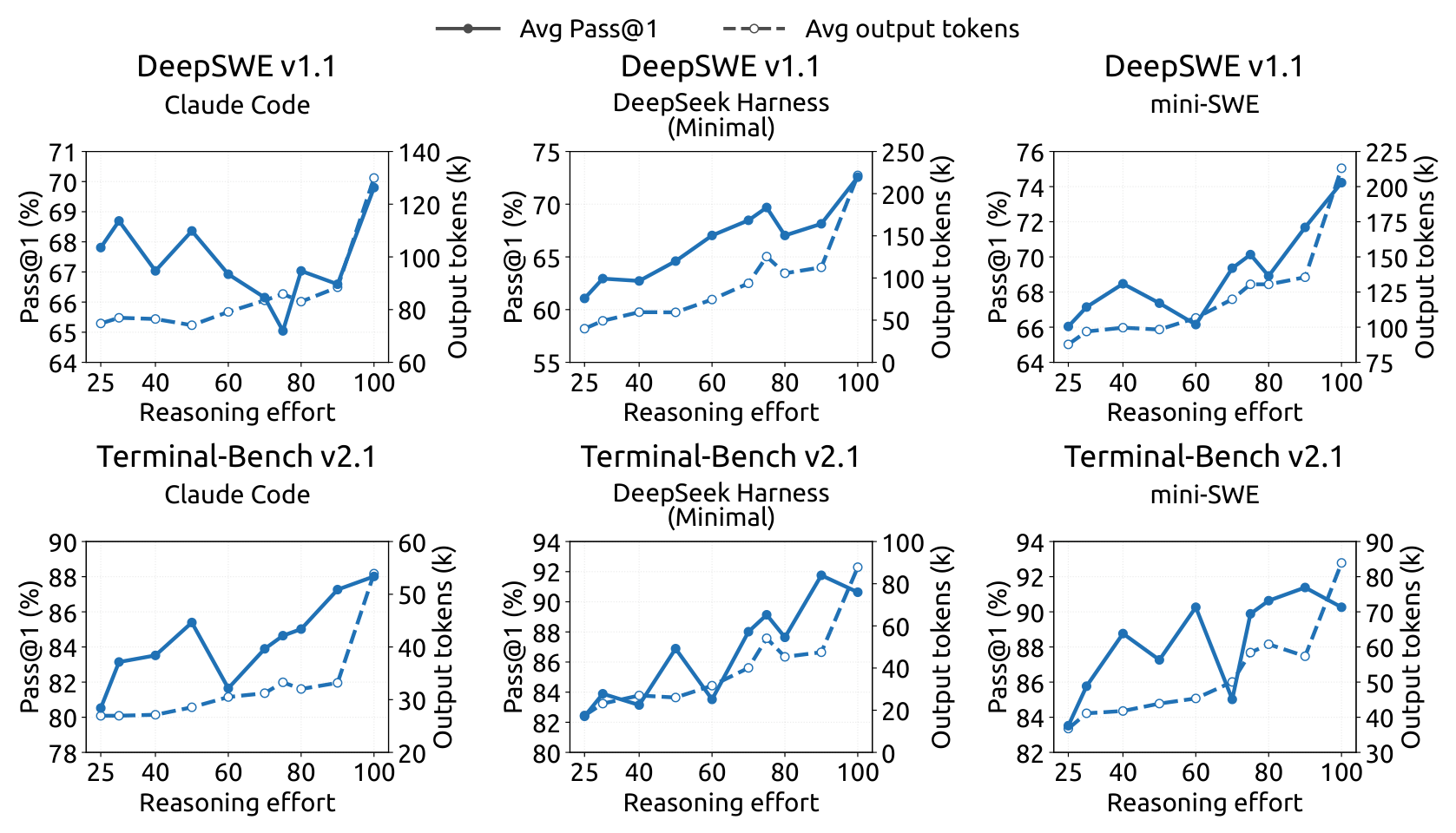
真实部署中模型不会绑定单一 agent 框架。评测覆盖 6 个 scaffold 家族的 8 种配置(Claude Code、Codex、OpenCode、Pi、mini-SWE、DeepSeek Harness 的 Minimal/Standard/PTC 模式),只换 harness、不换模型与解码配置:


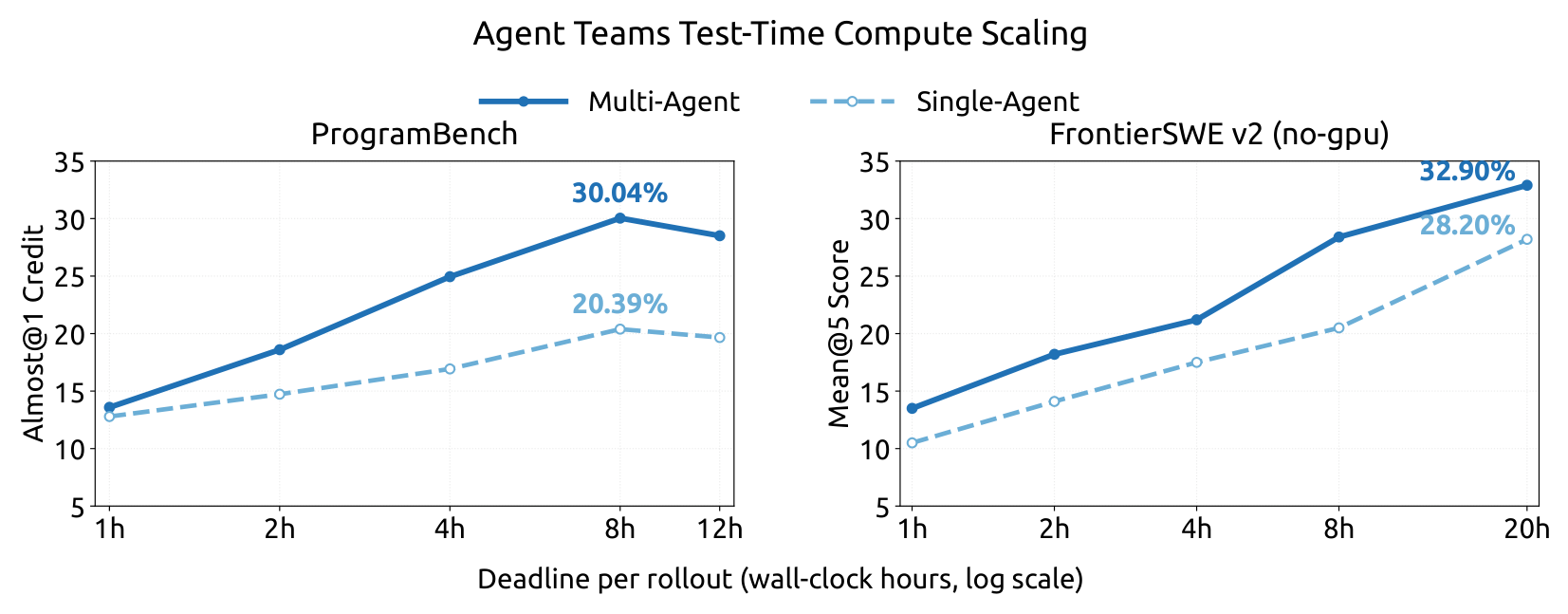
多智能体:Agent Team 模式的初步实验
用 DeepSeek Harness 的 Agent Team 模式探索多智能体协作:lead agent 可经 spawn_teammate 异步创建命名持久队友(新开模式不带 lead 历史,或 fork 模式带一次 lead 已完成轮次的快照);共享同一仓库检出,编辑即时互见;经持久 peer 邮箱通信(消息在队友下一步边界送达/唤醒);任务板维护所有权、依赖与建议写入范围(更新带修订检查);必要时仅 lead 可 interrupt_agent 打断队友。训练奖励 = 任务表现 + 鼓励委派与通信的协作加分 + 派生延迟惩罚:把执行事件及其协作依赖表示为 DAG,按固定 prefill/decode 速率折算 token 成本加实测工具执行时间,取关键路径长度——奖励有用的并行、惩罚不必要的串行与同步,且对服务端批处理/排队的延迟不敏感。
评测用 ProgramBench 高置信子集(只留参考解在隐藏测试上 ≥95% 通过的 172 个"golden"任务)与 FrontierSWE v2 的 no-GPU 子集:
附录补充:努力控制在各 scaffold 与各基准上的细粒度行为
术语速查
阅读中遇到缩写,可随时回到这里;正文里带虚线下划线的缩写悬停即可见释义。
| 缩写 | 全称 | 一句话解释 |
|---|---|---|
| MoE | Mixture-of-Experts | 混合专家:每 token 只激活少量专家,总参数大而激活参数小 |
| CED | Causal Encoder-Decoder | 因果编码器-解码器:下半层当编码器,上半层 KV 由编码器终态投影,prefill 计算减半 |
| CSA2 | Compressed Sparse Attention 2 | 第二代压缩稀疏注意力:跨层共享主 KV/索引器 K,并复用 Top-K 索引,分 Full/Reindex/Reuse 三模式 |
| SWA | Sliding-Window Attention | 滑动窗口注意力:每层只看最近 n_win=128 个 token,存储有界 |
| KV Cache | Key-Value Cache | 注意力的键值缓存:长上下文部署的核心内存开销 |
| MLA / GQA | Multi-head Latent / Grouped-Query Attention | 条目维压缩的两条路线:跨头共享潜在向量 / 减少 KV 头数 |
| HSI | Hierarchical Sparse Indexer | 层级稀疏索引器:解码器首个 Full 层建 16,384 位置候选池,深层索引成本变常数 |
| mHC | Manifold-constrained Hyper-Connections | 多残差流混合;Single-Pass 版把混合系数挪前一块,单 kernel 达访存下界 |
| QAT | Quantization-Aware Training | 量化感知训练:训练中模拟量化,保住低精度(FP4/FP8)下的精度 |
| MXFP4 | Microscaling FP4 (OCP) | OCP 标准的块缩放 FP4 格式;本文用 E2M1 + 每 16 通道 E4M3 缩放 |
| EPD | Encoder-Prefill-Decode | 推理部署三分离:视觉编码、预填充、解码独立扩缩与重叠 |
| SWA Bounded Replay | — | 只回放最近 n_win 个 token 近似重建 SWA KV,免持久化 SWA、prefill 再减半 |
| DSec | DeepSeek Elastic Compute | 百万级并发沙箱平台:分片 + 放松一致性调度 + 高密度 NUMA 隔离 |
| OPD | On-Policy Distillation | 在策略蒸馏:学生对自己采样、教师给全词表监督,后训练末段 |
| SFT / RL | Supervised Fine-Tuning / Reinforcement Learning | 后训练标准两段:监督微调 + 强化学习 |
| DSH | DeepSeek Harness | DeepSeek 自家 agent 框架,有 Minimal/Standard/PTC/Agent Team 等模式 |
| BPB | Bits-Per-Byte | 逐字节比特数(困惑度换算),越低对语料压缩越好 |
| HLE / ALE | Humanity's Last Exam / Agents' Last Exam | 两个"最后考试"基准:人类知识极限 / 智能体能力极限 |
点评与展望
论文自己的结论与坦白的局限
作者总结:V4.1-Flash 通过架构、缓存精度、部署策略的联合优化,把 KV Cache 压缩推向新极限——全局 KV 890 字节/token(≈ V4-Flash 的 1/4),持久缓存 ≈ 1/8;激活 footprint 远小于 GLM-5.3、Kimi-K3 等开源同行,而在关键基准上可比甚至更优。局限也写得清楚:
- 鲁棒性边界尚未完全刻画:CSA2 的选择错误与 Bounded Replay 的近似重建,在未测试的极端输入/部署条件下可能造成能力退化;内部评测未观察到系统性退化,但有限测试集不可能覆盖一切,团队将持续加压测试(重点是长上下文稀疏检索与缓存续传边界的 SWA 重建);
- 基准饱和与真实前沿的差距:分数接近 Fable-5、GPT-6 Astra 不等于在最难任务与边界案例上对齐闭源前沿;评测协议会持续更新;
- 下一步:数据、模型容量、RL 的协同扩展;模型-harness 协同设计(把 agent 框架当作系统的一部分一起优化)。
编者点评
这份报告最值得学的是"账本思维"。每个设计都对应一笔可验证的账:CED → prefill 减半(8B 激活);CSA2 + FP4 → 全局 KV 1/4;Bounded Replay → 持久 KV 1/8、代价是 $n_{\text{win}}$ token 的重算;mHC → 激活访存 $(4n+4)d \to (2n+2)d$;Sinkhorn → 优化器状态只剩动量缓冲。很少见到把"每 token 每字节"的工程账算到这个颗粒度、且每笔都给出实验背书的技术报告。
其次是对"近似"的务实态度。Bounded Replay 在数学上不严格——重建的 SWA KV 与精确版本不逐位一致——但作者用三道保险把风险关住:实验证明质量损失可忽略、后训练中模拟同样的回放做训练感知适应、以及持续的压力测试计划。系统设计里"可接受的近似 + 明确的边界刻画"比"处处严格"更可扩展。
第三是后训练的"反炼金"宣言。SFT→RL→OPD 一字未改,全部收益来自可验证任务与环境的工业化生产。加上 DSec、异步 rollout、样本级调度这些"无聊但关键"的基建,这份数据管线 + 基建的组合拳,可能比任何单一算法创新都更接近"持续扩展 RL"的真实路径。附录 C 用边际效用推导给指数惩罚一个理论动机,更是罕见的"工程配置配数学解释"的写法。
保留意见:① MGSM(80.2,低于上代 Flash 的 85.7)与 LongBench-V2 的表现提示压缩仍有代价,多语数学推理与超长文档理解的退化边界值得社区独立复测;② HLE 36.8 vs Opus-5 56.3 的差距说明"日常任务够用"与"前沿推理"是两回事——报告自己也承认了这一点,这个诚实值得肯定;③ CSA2 的静态模式分配(哪些层 Full/Reindex/Reuse)是手工设计的,能否学习化、能否随负载动态切换,是显然的后续空间;④ 多智能体结果来自"最强配置 vs 最强基线"的初步比较,结论强度有限,但方向已足够诱人。