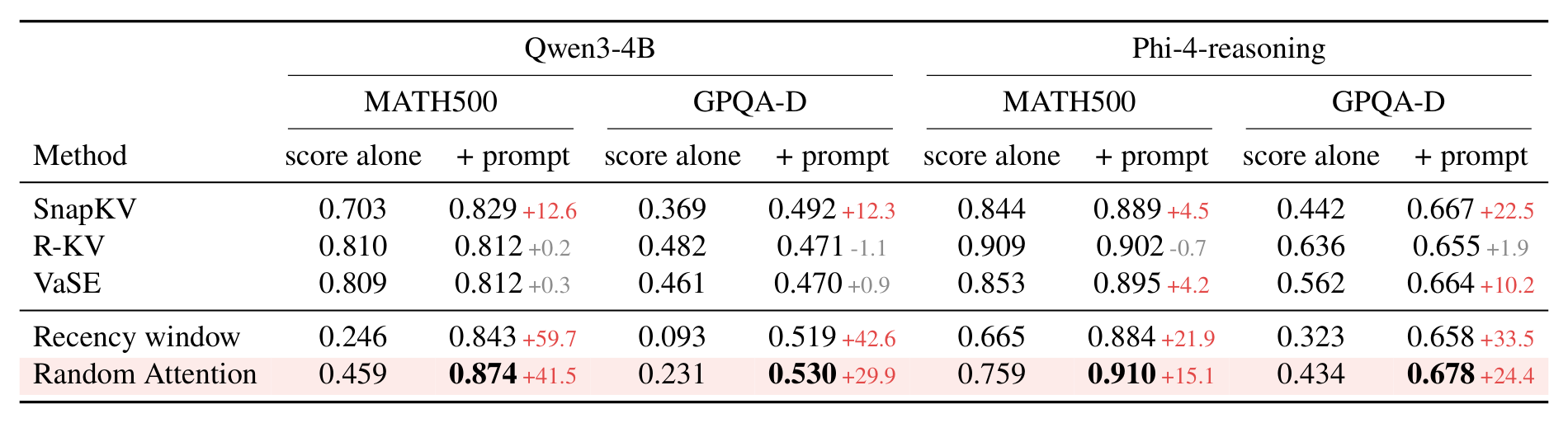
作者把 Random Attention 同时定位为可部署的方法和零假设(null hypothesis):任何打分式选择器如果在同等预算下打不过"随机",就说明它的信号没有提取到可用信息。两张总览图先把结论立住:
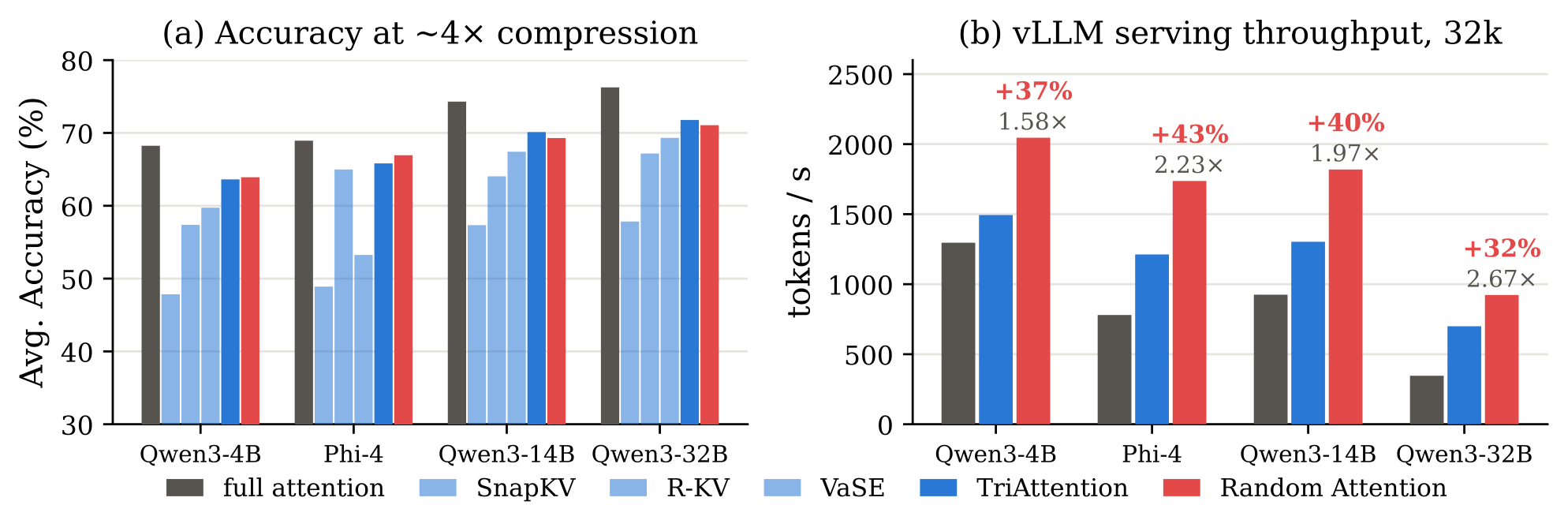
Figure 1:(a) Mean accuracy over the six reasoning tasks of Tables 1 and 5 at ∼4× compression: Random Attention matches the strongest prior evictor on every model. (b) vLLM serving throughput at 32k-token generations; labels give Random Attention's multiple of full attention and its margin over TriAttention.
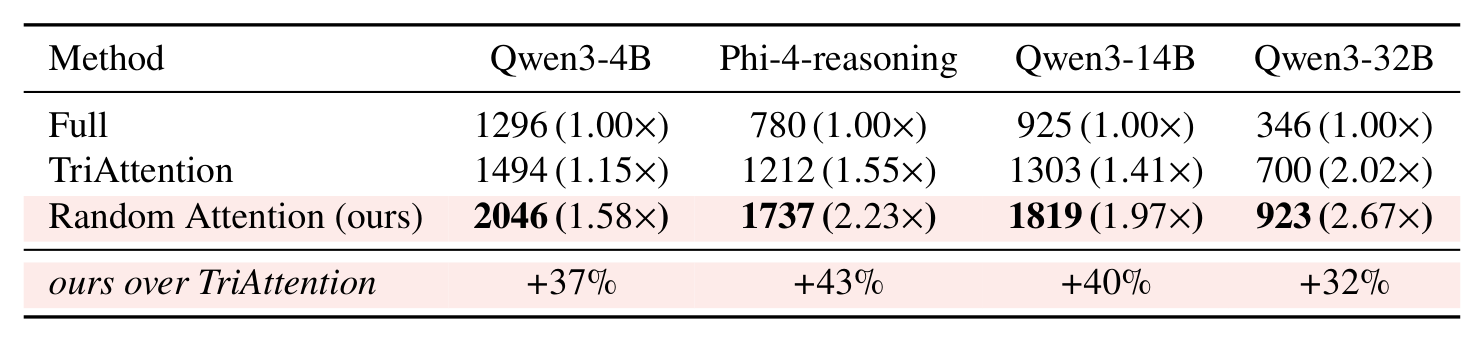
左图:约 4× 压缩下,六个推理任务的平均精度——四个模型上 Random Attention(最右柱)与最强基线 TriAttention 基本持平(14B/32B 的小差距主要来自代码任务,那里超长 prompt 吃掉了预算,见 §4)。右图:32k 生成的 vLLM 服务吞吐——Random Attention 达到 full attention 的 1.58×/2.23×/1.97×/2.67×,比 TriAttention 高出 +37%/+43%/+40%/+32%,原因很简单:它从不运行打分过程。
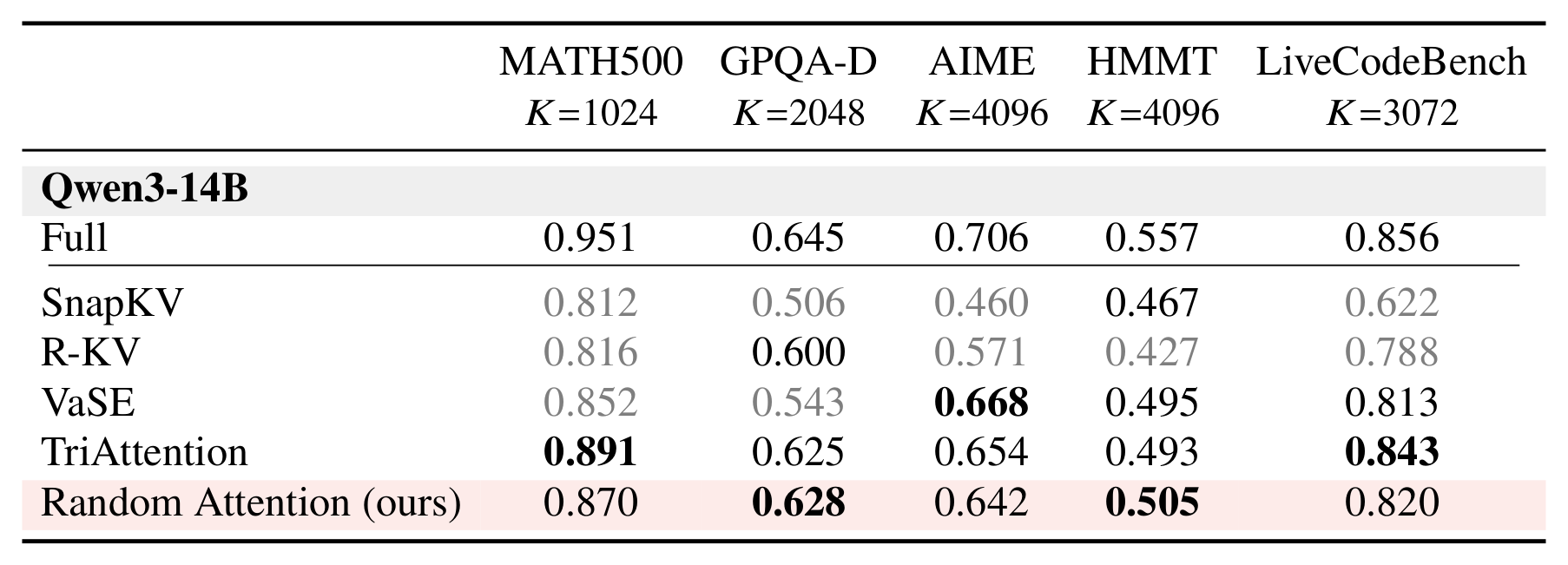
Table 5:Performance of Qwen3-14B with the same setting as in Table 1.
14B 的复制网格:Random Attention 在 MATH500(0.870)与 GPQA-D(0.628)上显著超过 VaSE 与 SnapKV,整体仍与 TriAttention 胶着(五任务各有胜负、差距都在 2 分级)。注意 LiveCodeBench 上 TriAttention 0.843 vs Random Attention 0.820——这是它在代码任务上跨 14B/32B 稳定出现的小优势,§4 末尾与 §5.1 会说明这更多是"长 prompt 预算"而非"选择信号"的故事。
压缩越紧,差距越大——而且对每个家族都一样
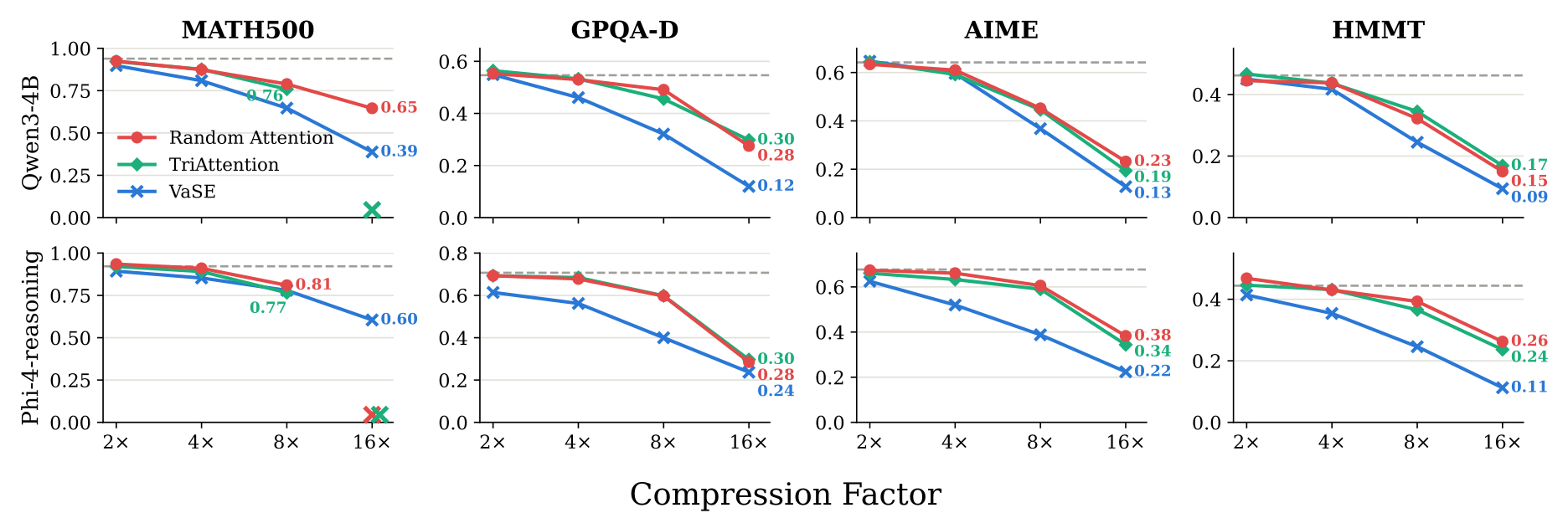
Figure 2:Accuracy from 2× to 16× compression on Qwen3-4B and Phi-4-reasoning, on the four math and science tasks; dashed lines mark full attention.
四个数学/科学任务上从 2× 压到 16×:2× 时所有方法都贴着 full attention(虚线);预算收紧后,Random Attention 与 TriAttention 继续并肩下行,而两者的领先带对 VaSE 逐渐拉开(如 Qwen3-4B MATH500 16× 处 0.39 vs 0.09)。"随机"并没有在压力下崩掉——它跟住了最强的打分基线。LiveCodeBench 不参与扫描,因为它的 prompt 在小预算下本身就放不下。
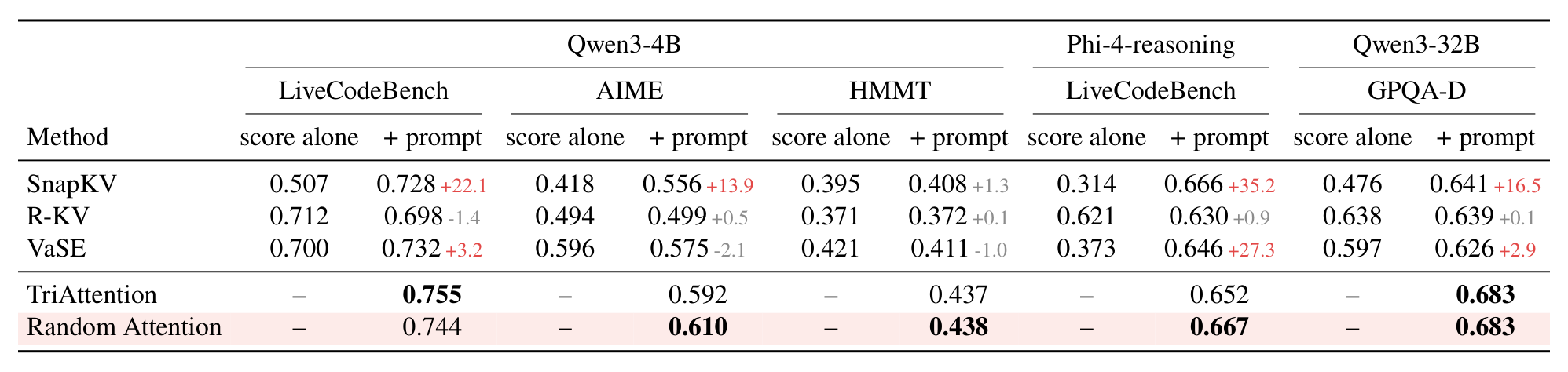
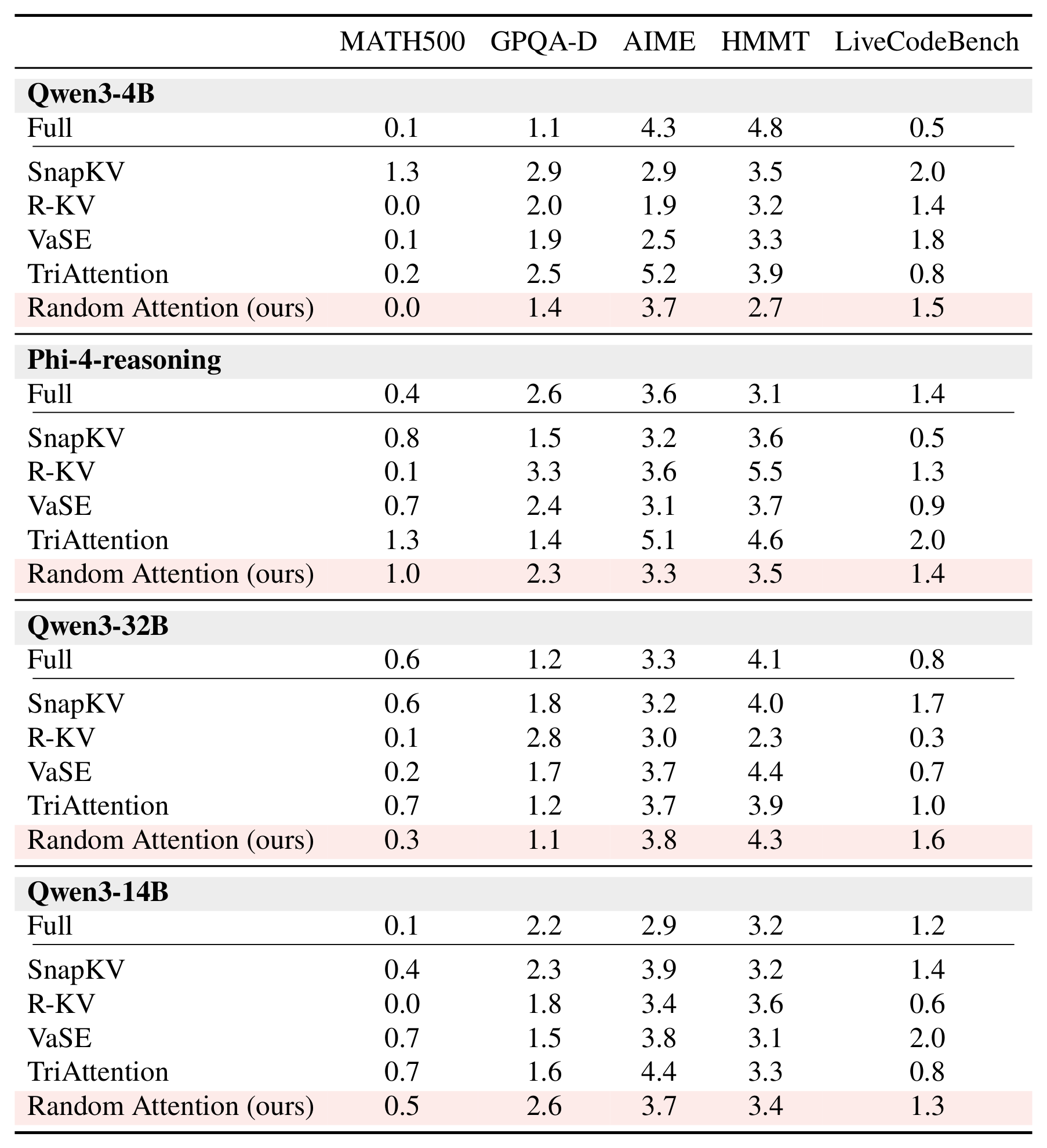
Table 6:Matched protection in the settings Table 2 does not cover (LiveCodeBench: pass@1; others: accuracy; AIME pools 2025+2026). Small numbers give the gain from the rule; bold marks the best protected method. TriAttention and Random Attention keep the prompt by construction and appear only in the protected column.
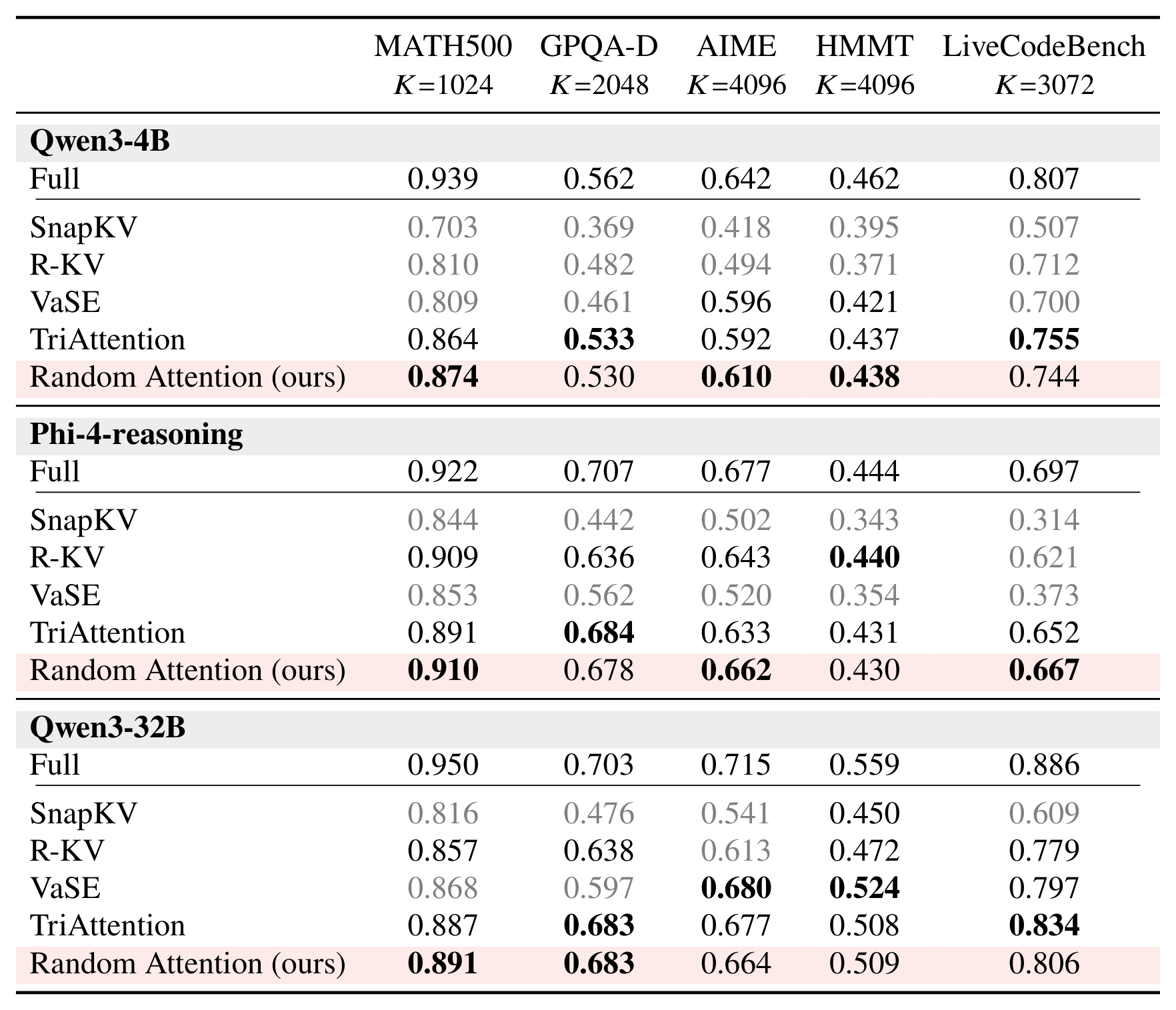
两个事实贯穿全部设置:① 回报跟随保留缺口——SnapKV 最大涨 +35.2(Phi-4 代码),R-KV 全程 −1.4~+0.9 约等于零;② 保护补上大分差但不补全部——在 32B GPQA-D 上,三个受保护的基线仍比 Random Attention 低 4–6 分,而"什么都不排序"的均匀抽取 + 规则在那里赢了每个受保护的学习型分数。另注意:TriAttention 与 Random Attention 构造上就保 prompt,所以 Table 1 里两者的每一格本来就是 matched-protection 对比——混淆变量只影响其余基线的"账面劣势"。
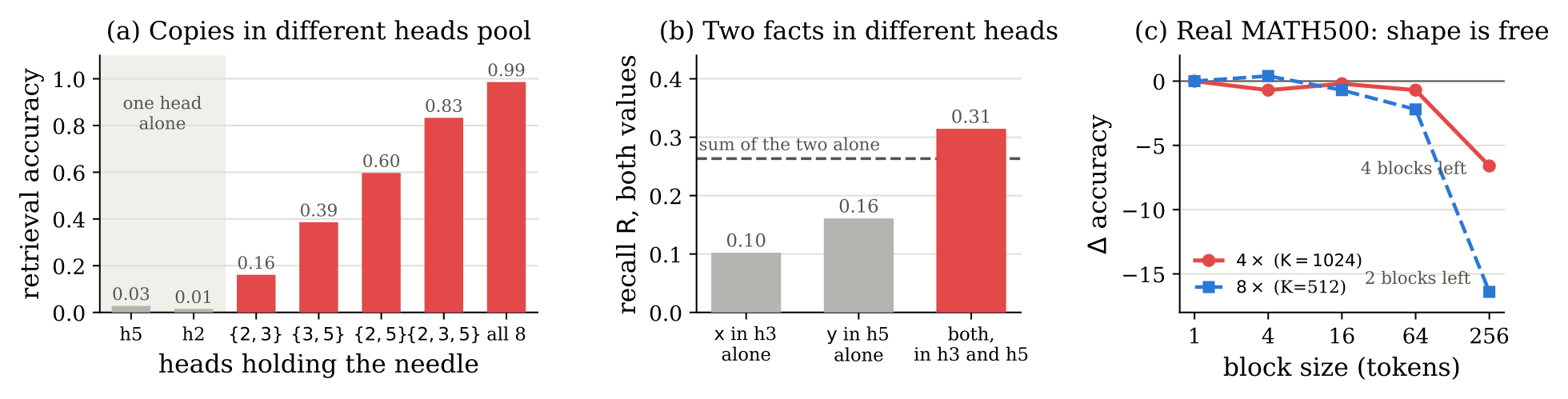
Figure 3:(a) A fact held in one head is almost never retrieved; held in several it is. (b) Two facts in different heads are worth more together than the sum of each alone (dashed). (c) Real MATH500: contiguous blocks cost nothing up to size 64; accuracy drops only once a head is left with 4 (K=1024) or 2 (K=512) blocks.
(a) 头是专门化的:Qwen3-4B 的 8 个 KV 头里只有 3 个能独立留住事实的可用痕迹,而且单头极弱——最好的单头检索率 0.03、次好 0.01;但读出不在乎是哪个头:同样两个头一起就是 0.60,三个 0.83,八个 0.99——池化强超可加,一对头的价值是两个单头之和的许多倍。(b) 池化甚至跨事实:答案需要两个值、分别放在不同头时,合并召回 R=0.31,远超单独 0.10 与 0.16 之和(虚线)。(c) 副本的形状无关紧要:把事实逐 token 摊到不同头(相邻 token 不同头、没有可读跨度),检索率 0.33 vs 完整句 0.39,R 0.75 vs 0.76;真实 MATH500 上把历史按 1→64 token 的连续块保留毫无损失,块长 256 才掉——且掉的原因是每头只剩 4(K=1024)或 2(K=512)个块:要紧的是每头块数,不是块长。对驱逐策略的直接推论:一个值只要有些头留着副本就仍可用——而"逐头独立抽取"恰好最大化这一点。
共享抽取对照(shared draw):最直接的任务级检验是把跨头多样性删掉——所有头共用同一份随机 keep-set。在真实 MATH500 上它只比 Random Attention 低 0.3 分($K=1024$:0.871 vs 0.874;$K=512$:0.788 vs 0.789)。也就是说:文本层冗余在真实轨迹上已经够用(要紧的东西被复述过,撒一次就撒中);跨头层承载的是"文本不复述"的部分——那正是植入探针构造出来的 regime。两层冗余互为替代,而 Random Attention 恰好两层都保。
Table 4:Serving throughput (output tok/s, and the multiple of full attention) under vLLM with PagedAttention on one H200 (K=2048, 1k-token prompts, 32k-token generations).
Random Attention 服务 2046/1737/1819/923 tok/s,达 full attention 的 1.58×/2.23×/1.97×/2.67×;比同内核的 TriAttention 快 +37%/+43%/+40%/+32%——它唯一的区别就是不打分。该差距不挑工况:8k 短生成上 +35%~+42%,容量上限处(Qwen3-4B 224 并发、14B 满)仍 +41%/+42%;单请求时两者只差 1%(115.8 vs 117.0 s)——服务差距是同步点放大的批量成本,不是单流内核差。
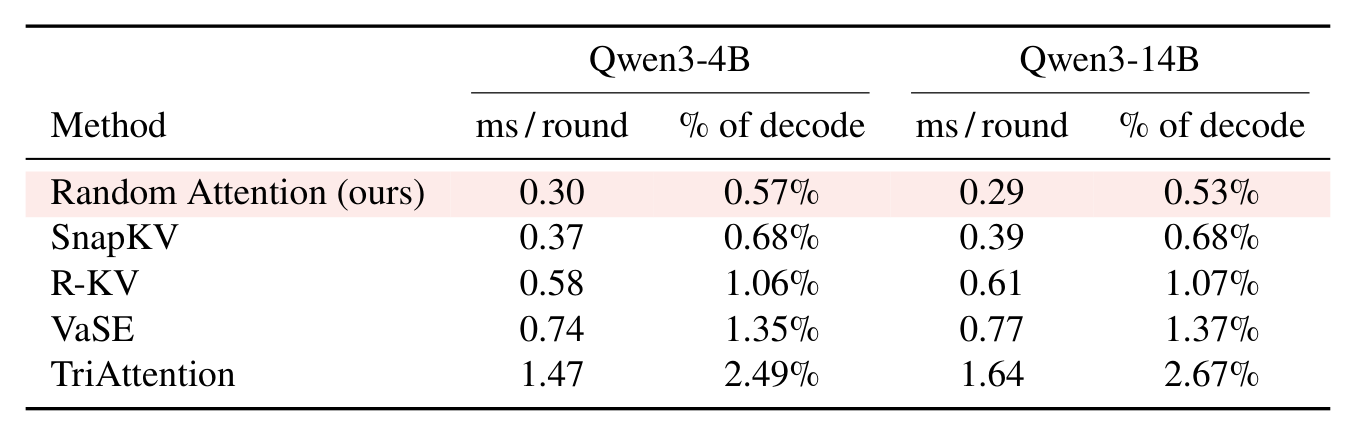
Table 9:Cost of one eviction round (scoring + compaction), measured with CUDA events on an otherwise idle H200: K=1024, 4096 decode steps, single stream. Random Attention performs no scoring, so its round time is the compaction floor every evictor pays.
逐轮成本阶梯:Random Attention 0.30 ms = 所有驱逐器都要付的压缩下限;SnapKV 0.37、R-KV 0.58、VaSE 0.74、TriAttention 1.47–1.64 ms(4B/14B)——超出下限的部分就是"选择信号的价格"。排序不变,且模型大小变 3.5× 也不变(每调用成本差 <12%)。
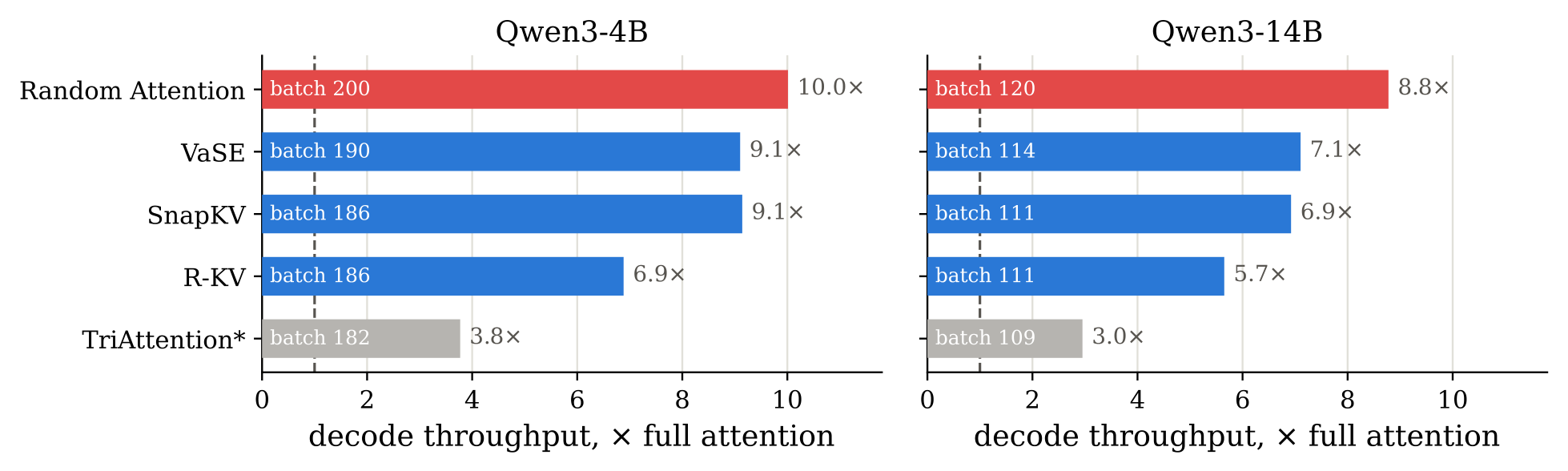
Figure 5:Equal-memory serving: decode throughput relative to full attention at each method's largest batch on one H200 (K=3072, 32k generations). ∗TriAttention here is an unfused re-implementation of its scorer, far slower than the vLLM version.
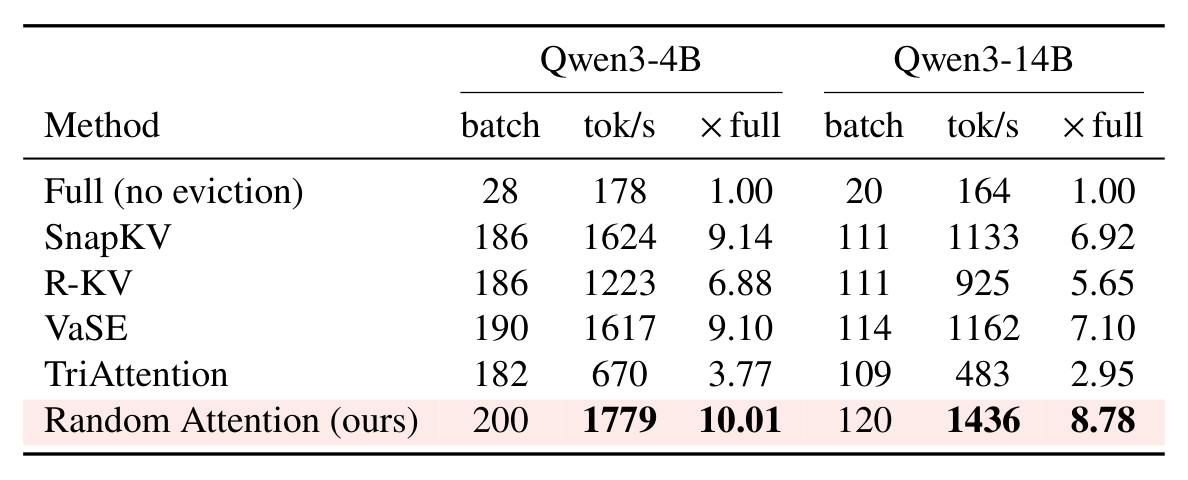
柱高排序:Random Attention 10.0×(batch 200)/ 8.8×(batch 120)居首,SnapKV 与 VaSE 9.1× 一档,R-KV 6.9×/5.7×,TriAttention 行(带 ∗)3.8×/3.0×——注意这是作者 PyTorch 复现的未融合打分器,远慢于其发布内核;在 vLLM 上它与 Random Attention 的差距是 1.4× 而非这里的 2.7–3.0×。所以方法层面的公平结论以 Table 4 为准,本图用于隔离"打分开销"这一个变量。Table 10:Serving throughput when each method runs at the largest batch that fits one 143 GB H200, at K=3072 with 32k generations. The small cache is what buys the batch, so every evictor collects most of the win; the ordering among them follows the cost of their scoring pass.
精确数字:full 178/164 tok/s(batch 28/20);Random Attention 以最大 batch(200/120)与最小峰值显存(101/89 GB)拿到 1779/1436 tok/s = 10.01×/8.78×;同代码路径的 SnapKV 1624、VaSE 1617、R-KV 1223(4B)——排序完全跟随打分开销。16k 生成时排序不变。
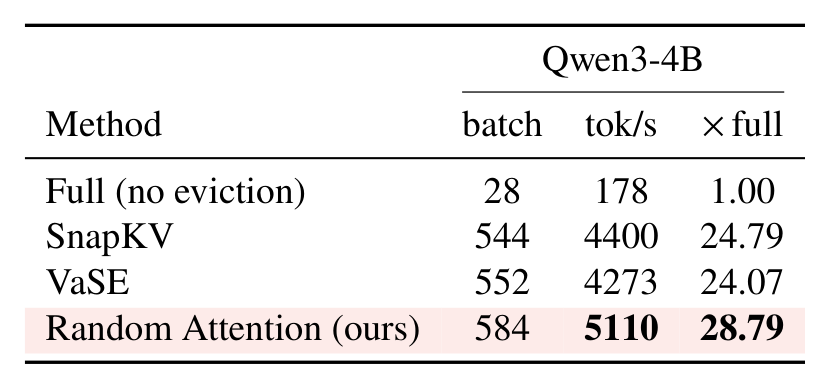
Table 11:Equal-memory serving at K=1024 (Qwen3-4B, 32k generations, one 143 GB H200): the tighter budget fits a batch of 584 against 28 for full attention, and Random Attention reaches 28.8× full-attention throughput.
紧预算的放大效应:batch 584 vs 28,Random Attention 5110 tok/s = 28.79× full attention——压缩带来的容量红利随预算收紧继续增长,而"免打分"在每一档都再多拿一截。R-KV 与 TriAttention 未在此预算下测量。
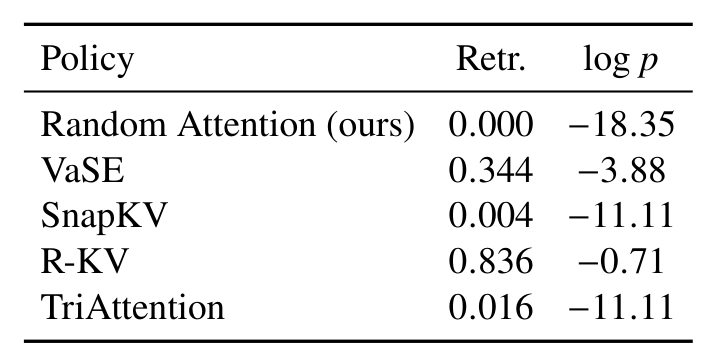
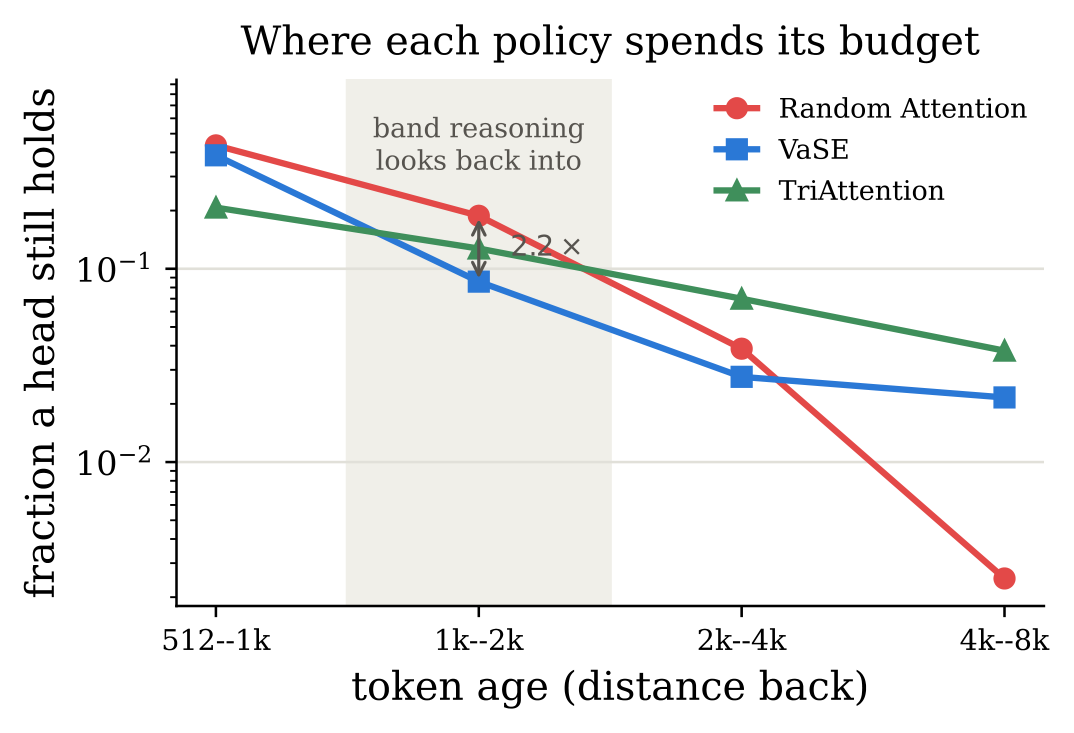
Figure 4:Fraction of positions of a given age that a head still holds (log scale; Qwen3-4B MATH500, K=1024). Random Attention decays geometrically with age; VaSE concentrates and freezes a tail of old favourites; TriAttention spends almost uniformly across ages.
三种"花钱形状"一目了然:Random Attention 随车龄几何衰减(软近期窗,各头的尾巴互不相同);VaSE 集中在少数"旧爱"上并冻结成尾;TriAttention 几乎均匀铺在各年龄段——单头保留不比 Random Attention 少多少,但各头几乎保同样的位置(1–2k 带跨头并集只有 0.199,是所有逐头策略里跨头多样性最低的),而 Random Attention 同带并集 0.776。"推理回看带"约为 2.2× 车龄范围——各策略都在这段带内做文章,但形状并不决定精度(§5.2),决定性的是有没有副本幸存。
驱逐会拉长生成——但 Random Attention 拉得最少
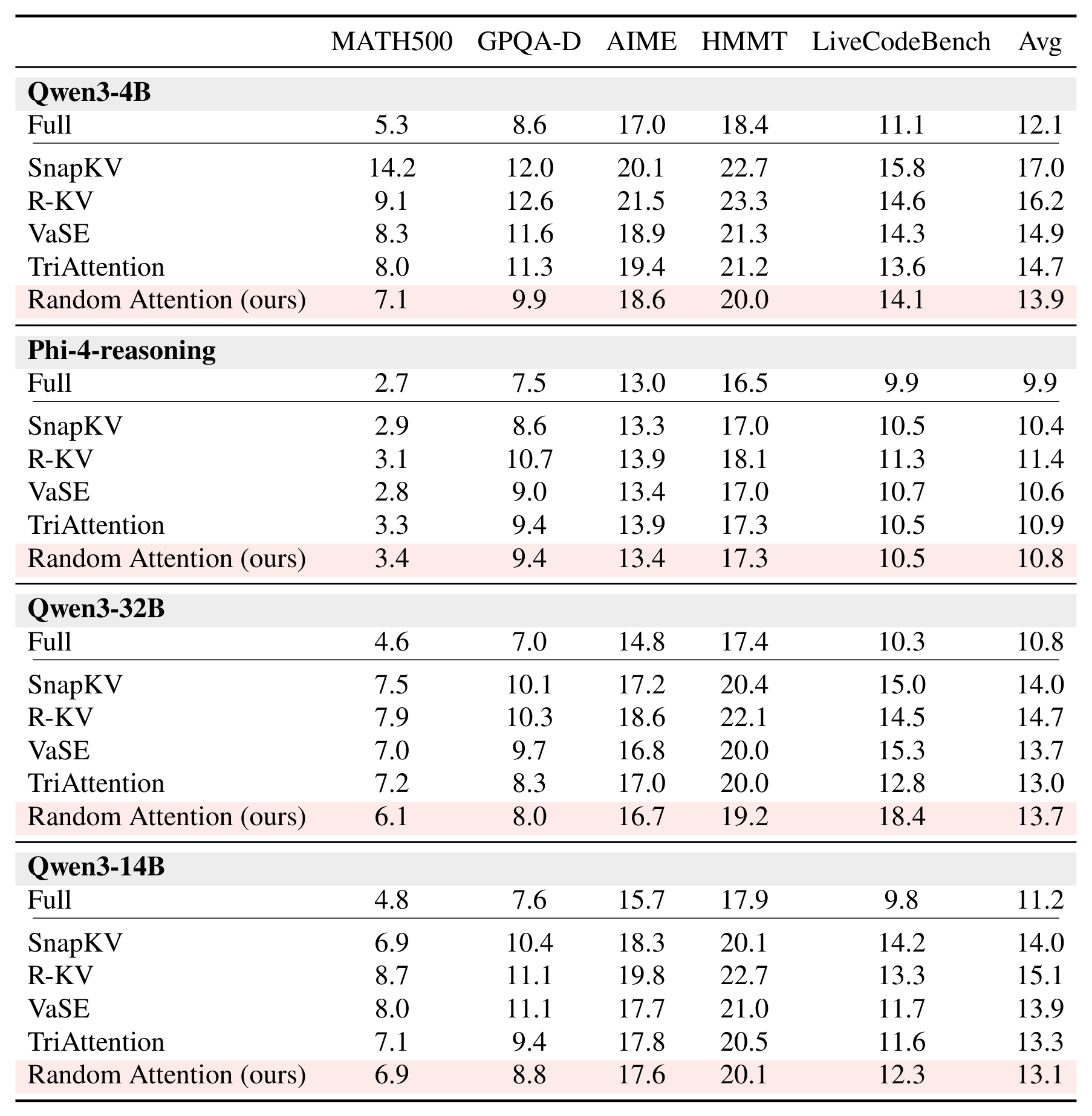
Table 7:Mean generated tokens (thousands) per cell of Tables 1 and 5, measured over every run of the cell; Avg = unweighted mean over the five tasks.
两个观察:① 驱逐普遍让生成变长(丢东西→重新想),最弱的选择器拉得最多(SnapKV 平均 17.0k vs full 12.1k,4B);② Random Attention 是 Qwen3-4B/14B 上生成最短的驱逐器(4B 平均 13.9k,14B 13.1k),另两个模型也只比最短者多 ~5%——它的精度持平不是靠更长的生成买回来的。32B 的 LiveCodeBench 例外(18.4k,该格生成最长),与其代码预算紧张一致。